SoftNest Journal
The 2 A.M. Bottle: What a Formula Mixing Pitcher Actually Changes
A practical look at batch-preparing formula with the Dr. Brown's 32oz mixing pitcher — what it simplifies, what it doesn't, and how to handle refrigeration, ratios, and leftovers safely.
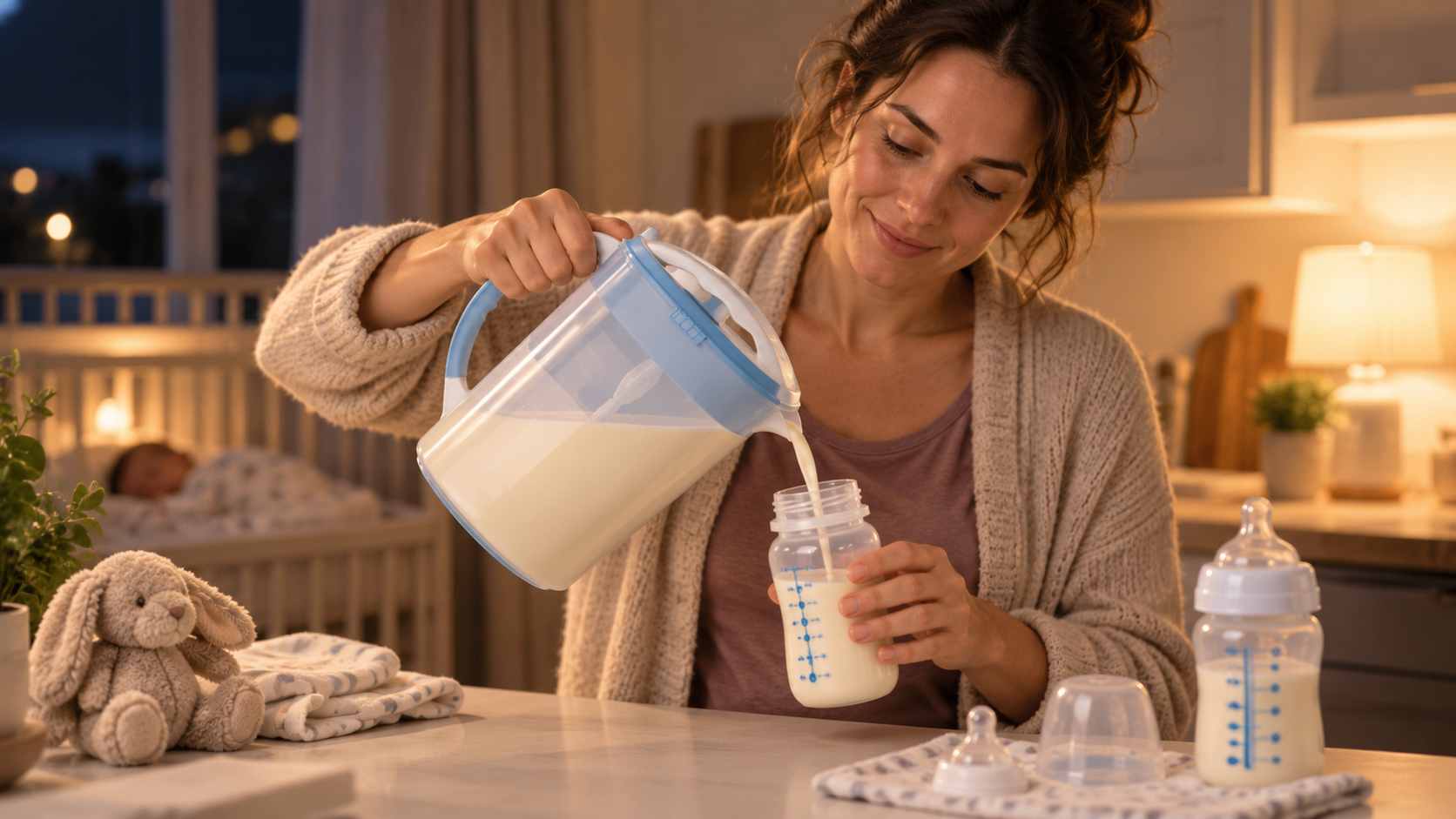
The 2 A.M. Bottle: What a Formula Mixing Pitcher Actually Changes
It's 2 a.m. Your baby is awake and hungry. You're doing math in the dark water to the line, scoops counted twice because you lost track, lid on, shake, test the temperature, try to soothe a crying baby with your free arm. Then you do it again at 5. And again at 7.
If you formula feed, or combination feed with pumped milk and formula, that loop runs several times a day and night. It's one of the more quietly exhausting parts of feeding not hard, exactly, just relentless.
The practical answer: a mixing pitcher lets you prepare several bottles' worth of formula at once, refrigerate it, and pour what you need when you need it. Fewer scoops, fewer shakers, fewer decisions made while half-conscious.
It won't stop the wake-ups. Nothing does. But it can shorten the stretch between "baby is crying" and "baby is eating," which at 2 a.m. is most of the battle.
One Mixing Session Instead of Six
Dr. Brown's 32oz Formula Mixing Pitcher holds 32 ounces and is designed for batch preparation a locking lid, an adjustable mixing stopper, and a no drip spout. Instead of measuring and mixing into a single bottle each time, you make the whole batch in one go and pour out individual servings.
That's the entire idea. It isn't a machine, it doesn't need a counter footprint or a setup routine, and it doesn't ask you to learn anything new. It just moves the measuring and mixing to a time when you're awake enough to do it carefully.
Which matters, because careful is the whole safety story with powdered formula.
What a Prepared Night Actually Looks Like
Here's one version of a routine that works for a lot of families:
Before bed, mix the batch. Measure the water first, then the powder, using the ratio your formula manufacturer specifies. Secure the lid, mix, and put the pitcher straight into the refrigerator.
When baby wakes, pour the amount you expect them to take into a clean bottle. Warm it if your baby prefers warm milk, following safe warming practices for your bottles and any warming device. Feed.
That's it. The measuring and the scoop-counting already happened hours ago, when you had both hands and a functioning brain.
During the day the same batch covers morning feeds, the bottle you pack for daycare, and the early-evening cluster. If your baby takes several bottles a day, or you have twins or multiples, the math gets even more favorable — more bottles per mixing session means more repetition removed.
If your baby only takes an occasional formula bottle, though, be honest with yourself. A 32-ounce pitcher may be more capacity than you'll use before the batch needs to be finished, and a smaller container or single-bottle prep might suit you better.
Advantages Worth Naming
- Less repetition. Measure and mix once instead of every feeding.
- Fewer scoops at night. The part most likely to go wrong when you're tired happens less often.
- Less shaking. The pitcher is built to mix a larger volume smoothly, so you're not vigorously shaking bottle after bottle. Vigorous shaking can introduce air, which some babies notice.
- Cleaner pouring. The locking lid and no drip spout help when you're transferring formula into a bottle one-handed.
- Simple counter economics. Where larger formula prep machines take up counter space and require their own setup and cleaning routine, a pitcher is a container. Rinse, wash, dry, done.
Where It Doesn't Help You
The pitcher does not measure for you. You still measure the water and count the scoops. The CDC warns that adding too much or too little water to powdered formula can be unsafe for babies, so the exact water-to-formula ratio on your formula's label is not a suggestion — it's the recipe. A pitcher makes mixing easier; it doesn't make measuring optional.
It also doesn't manage time for you. Because you're making a batch in advance, refrigeration and timing become part of your routine rather than an afterthought. Health Canada's guidance for prepared formula is a useful reference point: formula that won't be used right away should be refrigerated at 4°C (about 40°F) or below and used within 24 hours, alongside whatever your formula manufacturer says. Your local health authority may phrase this slightly differently, so check the guidance where you live and follow the shorter window if it differs.
And there's a hard stop on leftovers. Once a baby has started drinking from a bottle, that formula shouldn't go back into the pitcher or be saved for the next feeding saliva can let bacteria multiply. What baby doesn't finish gets discarded. This means batch preparation works best when you're pouring amounts you can reasonably predict.
One last limitation: if you're in the very early days of figuring out how much your baby takes per feed, batch prep can feel like guessing. Many parents find single bottle mixing easier until volumes settle into a rhythm.
If You Pump and Also Use Formula
The pitcher is built for powdered formula, not for mixing or storing breast milk. That distinction is worth keeping clear.
What it can do for combination feeding families is take over the formula side of the equation. Instead of mixing formula from scratch every time you supplement, you make a batch once and pour as needed — while pumped milk continues to be stored separately according to breast milk storage guidance. Two systems, each with its own rules, but one of them stops demanding your attention every few hours.
Cleaning, Storage, and the Small Stuff
A few operational details that don't come up until you own one:
- Wash after each batch. Components that touch formula need proper cleaning between uses. Check the manufacturer's care instructions for what's dishwasher-safe and what isn't.
- Label the batch. A piece of tape with the mixing time on the pitcher removes the "when did I make this?" question entirely.
- Refrigerate promptly. Formula meant for later shouldn't sit out while you attend to other things. Mix, cap, refrigerate.
- Pour, don't dip. Pour from the spout into bottles. Don't put a used bottle back into the pitcher.
- Store it empty. Once the batch is used or expired, wash and let the pitcher air-dry rather than leaving formula residue in it.
Is It Worth It?
This pitcher solves one specific problem: preparing a fresh bottle from scratch every time your baby gets hungry. If that's your reality several times a day especially overnight batch preparation genuinely reduces the number of repetitive, error-prone steps in your feeding routine.
It's worth skipping if you formula feed only occasionally, if your baby's intake is still changing week to week, or if you already have a preparation system that's working and you don't want to add a container to the rotation.
It's a tool, not a transformation. The wake-ups stay. The bottle still has to be poured, warmed, and washed. What changes is how much of that happens at 2 a.m. with you counting scoops by feel and for a lot of parents, that's the difference between a rough night and a manageable one.
Health and safety note: This guide is general education, not individualized medical or feeding advice. Powdered formula preparation, water-to-powder ratios, storage times, and refrigeration temperatures vary by product and by region, and your formula manufacturer's instructions and the health authority where you live take priority over anything here. Follow your own formula's label exactly, use the guidance or recall systems available in your country, and speak with a qualified pediatric or feeding professional about your baby's specific needs. If your baby shows signs of illness, dehydration, or a reaction after feeding, seek care from your local urgent or emergency services.
Keep reading
Two useful next stops.
2026-03-13
Is the Baby Brezza Formula Pro Advanced Worth It for Daily Bottle Prep?
A factual, practical look at what an automatic formula maker helps with, what it cannot do, and where it fits in a real feeding routine.
2026-06-16
Is a Large Bottle Sterilizer and Dryer Worth the Counter Space?
A realistic look at the Momcozy sterilizer and dryer, including capacity, drying, workflow, maintenance, and which feeding routines benefit most.