SoftNest Journal
Baby Nails, Cradle Cap and First Teeth: A Calm Care Routine
A practical baby-care routine for nails, hair, cradle cap, gums and first teeth, plus an honest look at when an all-in-one grooming kit earns its space.
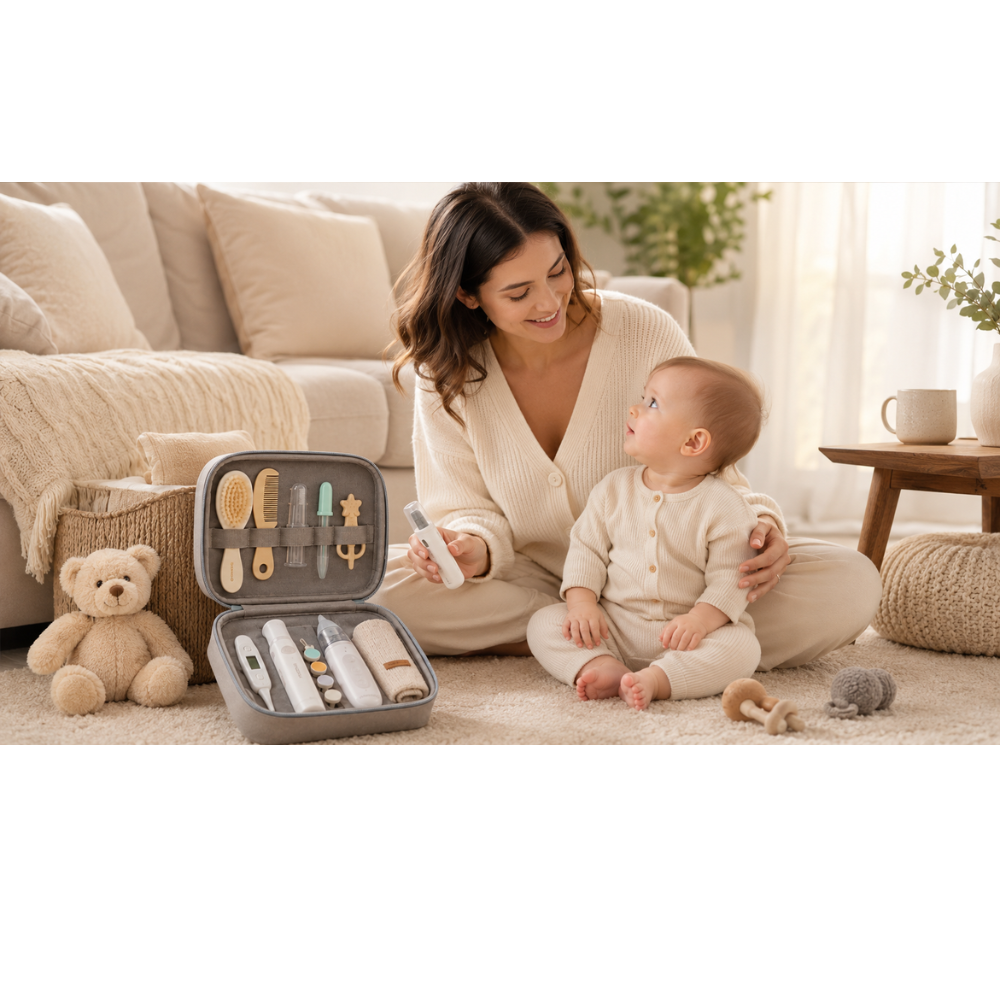
A newborn fingernail catches on your shirt. The soft brush has migrated to a bathroom drawer. The clean washcloth is downstairs, and the baby has just decided that waiting is an unreasonable adult invention.
This is how “basic grooming” starts to feel like a collection of tiny emergencies.
The calmer answer is not a longer checklist. It is one small care station and three repeatable jobs:
- smooth sharp nail edges before they become scratches
- keep the scalp comfortable without scrubbing it into submission
- clean the mouth gently, then switch to proper toothbrushing when the first tooth appears
An all-in-one kit can make those jobs easier to organize. It does not make every included tool essential, and it does not turn routine care into treatment. The useful part is having the right clean item where a tired caregiver expects to find it.
Build One Care Station Before Building a Routine
Choose a dry shelf or closed caddy near the place where you actually care for the baby. “Near” matters. A perfect setup in a distant nursery is less useful than a plain container beside the changing mat.
Start with:
- a baby nail file, suitable clippers, or an electric nail file
- a soft baby brush or comb
- clean washcloths or gauze for the gums
- a small, soft child-sized toothbrush for when a tooth appears
- a clean pouch or divided container for dry tools
- the instructions and charging cable for any powered device
Keep wet brushes out of a sealed case until they are fully dry. Store every small part, grinding head, cap, battery-powered tool, and teether beyond the baby's reach. A care kit belongs to the caregiver, even when every object inside it is pastel.
Do not place every health item in the same loose compartment. A thermometer should stay clean and easy to identify. Oral-care tools should not roll against a used nasal-aspirator tip. The storage case is helpful only if it prevents confusion rather than creating a well-organized soup of damp accessories.
Check Nails in Daylight, Trim Them in a Calm Window
Newborn fingernails are thin, quick-growing, and surprisingly effective. They may need filing or trimming about once a week, while toenails often need attention less often. The calendar is only a reminder; the real signal is a sharp edge, a snag, or a nail extending beyond the fingertip.
Look first. In good light, check each nail and the skin around it. If the baby is awake and waving both hands like an airport marshal, this is an inspection—not a trimming opportunity.
The easiest windows are often:
- while the baby is asleep in their safe sleep space and one hand is easy to reach without changing the setup
- after a feed when the baby is calm but the caregiver is fully awake
- after a bath, when nails may be softer
- with one adult holding and soothing while another handles the tool
Support one finger at a time. Press the fingertip pad gently away from the nail. Remove a small amount, then feel for a rough corner rather than trying to produce ten immaculate crescents in one sitting. It is completely acceptable to do one hand now and discover the second hand tomorrow.
For fingernails, smooth the corners so they cannot scratch. For toenails, avoid digging into the sides; if a toe looks swollen, painful, or ingrown, ask a healthcare professional what to do instead of cutting farther down.
Do not bite or peel a baby's nails. That is less controlled than filing or clipping and can damage the skin or introduce infection.
Choose the Nail Tool You Can Control
There is no universally superior baby nail tool. There is the tool a particular caregiver can use slowly, clearly, and according to its instructions.
A manual file
A fine baby nail file is simple, quiet, and useful for soft newborn nails or one sharp corner. It takes longer, especially once nails become firmer. Use light strokes on the nail edge and stop before the surrounding skin becomes irritated.
Baby clippers or scissors
These remove length quickly but demand a still hand, good light, and a clear view of the fingertip. Use a tool designed for infant nails, take small cuts, and finish any rough point with a file.
An electric nail file
An electric file can make gradual trimming feel less abrupt. It also adds grinding heads, speed settings, charging, noise, cleaning, and a short learning curve. Select the head and setting specified for the baby's age, secure it correctly, and practise operating the device before bringing it to a moving hand.
Use brief, controlled contact on the nail edge. Stop if the baby moves suddenly, the attachment loosens, or you cannot see exactly where the file meets the nail. “Electric” describes the motor; it is not a guarantee against skin injury.
If you accidentally nick the skin, stop the session and apply gentle, steady pressure with clean gauze or a clean cloth. Seek medical advice if the cut is deep, will not stop bleeding, or later becomes increasingly red, swollen, warm, painful, or produces discharge.
Hair Care Is Mostly Scalp Care
A baby does not need a salon schedule. Fine hair can be washed when it is oily, dirty, or carrying the memory of the last feed. Use a small amount of mild baby shampoo if needed, support the head securely, and rinse carefully.
A soft brush can lift loose flakes, smooth hair, and make a gentle after-bath ritual. It should not leave the scalp red. Use slow strokes, work around tangles instead of pulling through them, and be gentle over the soft areas of the head.
Brushes and combs collect skin, oil, and hair. Remove visible debris, clean each tool as its instructions direct, and let it dry completely. If two children use the same style of brush, label them. A tiny piece of tape can prevent a surprisingly long household investigation.
Cradle Cap Does Not Need to Be Picked Clean
Cradle cap commonly appears as greasy white, yellow, or darker scales on the scalp. It can look dramatic while causing the baby little or no discomfort. It is not evidence that the scalp was poorly washed, and it is not something to scrape off before company arrives.
For mild cradle cap, a gentle sequence is enough:
- Lightly massage a suitable plain emollient or a small amount of coconut oil onto the scaly area to help loosen it.
- Use a soft baby or cradle-cap brush without pressing hard.
- Wash with a mild baby shampoo.
- Rinse well, pat dry, and stop for the day.
Do not pick the crusts. Picking can break the skin and increase the chance of infection. Avoid adult shampoo, fragranced products, and improvised oils that are not recommended for infant skin. Current infant-skin guidance advises against using olive oil or peanut oil for cradle cap.
More brushing is not faster care. If the scalp turns pink from friction, the brush has already made its point.
Ask a pharmacist or healthcare professional before adding a medicated product. Have the baby assessed if the area is raw, bleeding, swollen, weeping, bad-smelling, spreading well beyond the typical areas, clearly painful or itchy, or not improving with gentle care. A fever in a baby younger than three months needs urgent medical assessment; do not assign it to cradle cap or teething.
Clean Gums Gently; Do Not Scrub for Invisible Teeth
Before teeth appear, use a clean, damp washcloth or gauze pad to wipe the gums gently. Once a day is an easy habit to attach to the evening wash. Wrap the cloth securely around a clean finger, use a fresh section as you move around the mouth, and stop if the baby is distressed.
A finger toothbrush can work for this early familiarization if it fits securely and its instructions allow the use. Inspect it before every session. If it is torn, loose, discoloured, or too large to stay firmly on the caregiver's finger, replace it.
There is no prize for vigorous tongue cleaning. Milk residue can be ordinary. Do not scrape the tongue or force a tool far into the mouth. Persistent white patches that do not wipe away, bleeding, sores, feeding pain, or concern about thrush deserve advice from the baby's healthcare professional.
Wash and air-dry reusable oral-care tools exactly as directed. Store them away from toilet spray, wet bath brushes, and the general population of the diaper bag.
The First Tooth Changes the Job
When the first tooth comes through, move from gum wiping alone to brushing the teeth twice a day with a small, soft child-sized toothbrush.
For children under three, recommendations about fluoridated toothpaste vary by location and by the child's risk of tooth decay. Ask an oral-health professional or physician where the child receives care. If fluoridated toothpaste is recommended, an adult should use only a minimal smear no larger than a grain of rice. Follow that local advice rather than borrowing the toothpaste routine of an older sibling.
Brush the front, back, and biting surface gently. The baby cannot spit reliably, which is why the toothpaste amount stays tiny and the caregiver controls the tube. Put toothpaste out of reach immediately after use.
Plan the first dental visit within six months of the first tooth appearing and no later than the first birthday, or follow earlier local or individualized advice. The early appointment is not an admission that something is wrong. It establishes a baseline and gives the family a place to ask about fluoride, tooth development, feeding habits, and anything unusual in the mouth.
Do not dip a pacifier or teether in honey, sugar, juice, or syrup. Honey is unsafe before twelve months, and sweet coatings expose new teeth to sugar. Do not treat fever, diarrhea, or a very unwell baby as “just teething.”
What an All-in-One Kit Actually Solves
The Momcozy All-in-1 Elite Baby Kit combines grooming, cleansing, and health-care accessories in a storage case. The manufacturer's manual lists a bath brush, cradle-cap brush, comb, finger toothbrush, teether, electric nail file, electric nasal aspirator, thermometer, heated tummy wrap, medicine pacifier, and the case.
That is a broad collection. Its strongest argument is coordination: several small items arrive together, their instructions can be stored in one place, and a first-time household does not have to source each category separately.
Its value is not that every tool becomes necessary. Nail care, scalp care, oral care, congestion, fever, abdominal discomfort, and medication are different jobs. A single case does not make them one routine, and the presence of a device does not mean it should be used whenever the baby is unsettled.
Treat the kit as a library, not a daily assignment.
Who May Appreciate the Kit
The bundle is easiest to justify when:
- a first-time parent is starting without basic grooming tools
- several caregivers need one agreed storage place
- an organized case is more likely to stay stocked than separate drawers
- the family expects to use the nail, scalp, and oral-care pieces regularly
- the buyer wants a practical shower gift and has checked what the parents already own
It may also help a family that moves between two regular care locations, provided powered products, small parts, and any health-care items are transported and stored safely.
The important word is “regular.” A large kit is not automatically economical if only two tools leave the case.
Who Can Probably Build a Smaller Set
Skip or simplify the bundle when:
- you already own a thermometer, nasal aspirator, or electric nail file
- your healthcare professional has recommended different equipment
- storage is tight and a compact file, brush, cloth, and toothbrush cover the real routine
- multiple powered devices feel like more charging and cleaning than convenience
- you prefer to choose each tool after learning what the baby tolerates
Buying separately also makes replacement easier. The toothbrush may need changing before the comb. A nail-file attachment may wear before the bath brush. A household does not need to replace a whole category because one small item has reached the end of its useful life.
Before buying, compare the current package contents with what is already in the home. Confirm the return policy, replacement-part availability, care directions, age or size limits, and current product or recall information. Bundles can change; the listing and manual supplied with the actual product are the authority for that unit.
The Work the Case Cannot Do
Every reusable item still needs its own cleaning and drying method. Every powered item still needs charging, inspection, and correct attachments. Every health device still needs instructions that the caregiver has read before an anxious moment.
Create three zones:
- clean and dry: files, combs, unused attachments, thermometer
- used and waiting to wash: an open washable container, never the closed storage case
- charged and ready: powered tools stored safely with their correct parts
Check the case once a month. Remove expired or damaged items, loose batteries, pieces the baby has outgrown, and anything nobody can identify without conducting an oral history.
Do not practise with a nasal aspirator, thermometer, medicine pacifier, or heated product for the first time while the baby is ill or distressed. Read the manual in advance and ask a qualified professional when the correct use is unclear. These products do not diagnose the reason a baby is unwell.
A Routine That Fits an Ordinary Week
Daily:
- look at the hands during a diaper change and feel for a sharp nail
- wipe the gums gently, or brush visible teeth morning and night
- keep the mouth-care tool clean and dry
On a bath day:
- wash hair only as needed
- use a soft brush briefly if the scalp is comfortable
- handle cradle cap gently rather than trying to clear every scale
- rinse, clean, and air-dry used tools before storage
Once a week:
- inspect fingernails and toenails in good light
- file or trim only what needs attention
- check reusable pieces for cracks, loose parts, or residue
- charge the electric file if its instructions and battery level require it
Once a month:
- empty and wipe the storage case
- match attachments to the correct device
- review replacement dates and instructions
- move outgrown or unused items elsewhere
The point is not to perform every task on Sunday evening. The point is to prevent each small job from becoming a surprise.
Give the Next Caregiver a Usable Handoff
If someone else will handle grooming, show them the actual tool and actual instructions. “It is obvious” is how an age-specific grinding head meets the wrong speed setting.
Tell the next caregiver:
- which nail tool you use and where to stop
- whether the scalp is being treated with anything
- whether the baby has a tooth and what amount of toothpaste is used
- which pieces are clean, which need washing, and which should not be used
- who to call if the skin, mouth, temperature, or behaviour causes concern
Medication and temperature-taking deserve a separate, explicit handoff. Never assume a storage case communicates a healthcare plan.
The Smallest Useful Version
If the whole subject still feels crowded, begin here:
- Put a file, soft brush, and clean cloth in one dry place.
- Inspect nails when the baby is calm; do not force a trimming session.
- Brush the scalp gently and leave ordinary scales alone between wash days.
- Wipe gums once daily.
- Add a soft toothbrush when the first tooth appears, and follow local professional advice about a rice-grain smear of fluoride toothpaste.
- Clean, dry, and return each tool after use.
That is a complete beginning. Add a specialized tool only when a real task calls for it and you understand how to use it.
Baby grooming becomes less overwhelming when it stops being an event. One nail gets smoothed. One brush gets rinsed. One tiny tooth gets brushed before bed. The routine grows with the baby, and the caddy stays small enough to tell the truth about what you actually use.
Disclosure: SoftNestStyle may earn a commission if you buy through a product link, at no extra cost to you. Editorial judgments remain independent, and product details should be confirmed with the current manufacturer listing and manual.
Health and safety note: This guide offers general education, not individualized medical, dental, or product-use advice. Recommendations, urgent-care pathways, emergency numbers, product approvals, and professional roles vary by location. Follow your baby's healthcare and dental professionals, current guidance from the health authorities where you live, and the instructions supplied with each tool. Seek urgent assessment for a fever in a baby younger than three months using the fever definition and care pathway provided locally, and contact local emergency services for severe bleeding, breathing difficulty, blue or grey colour, unresponsiveness, or another life-threatening concern.
Keep reading
Two useful next stops.
2026-04-25
Diaper Changes Without the Daily Drama
A practical diaper-changing setup that keeps wipes, cream, clothes, and cleanup where they belong instead of turning every change into a small search party.
2026-08-23
Diaper Changes 101: Keep Baby Clean & Rash-Free
A simple, first-time-parent guide to diaper changes: how often to change diapers, when to use wipes, how to clean gently, what diaper cream actually does, and when a rash needs medical attention.