SoftNest Journal
Can’t Get Comfortable While Pregnant? What a U-Shaped Pillow Actually Changes
A practical look at U-shaped pregnancy pillows: side-sleep support, cooling-cover limits, bed space, setup, care, and who may prefer a wedge.
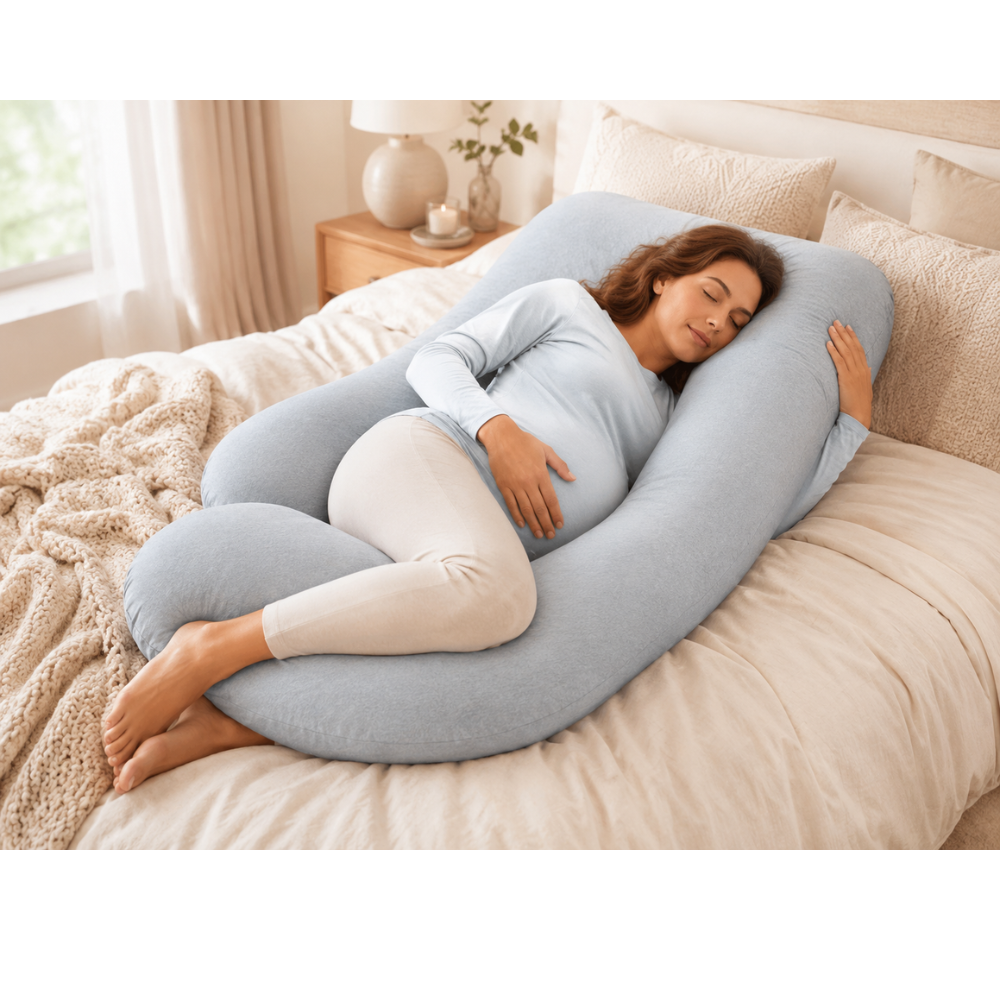
The room is dark. The pillow under your belly has gone flat. The pillow between your knees is making a determined escape toward the foot of the bed, and the one behind your back is now doing excellent work for nobody.
Then you need to turn over.
Pregnancy can turn an ordinary change of side into a small furniture-removal project. A U-shaped pregnancy pillow offers a believable fix for that particular problem: it puts continuous cushioning in front of you, behind you, and between your legs, so several support points move as one setup instead of four unrelated pillows.
The Momcozy U-Shaped Cooling Fabric Pregnancy Pillow adds a removable, machine-washable cover that the manufacturer describes as heat-dissipating. That may make the surface feel less warm than a plush cover. It is not active cooling, a treatment for pregnancy pain, or a guarantee of better sleep.
That distinction matters. Buy a large U-shaped pillow when the nightly problem is scattered support and repeated rearranging. Choose something smaller when you need one targeted lift, share a narrow bed, or dislike being surrounded by bedding.
Start With the Part of Bedtime That Is Failing
“I cannot get comfortable” can describe several different problems.
Your belly may feel unsupported on your side. The top hip may rotate forward. Your knees or ankles may press together. Your lower back may want something behind it. Your head pillow may suddenly feel too low. You may be comfortable for ten minutes but unable to turn without rebuilding the bed.
A pillow can help with position and pressure. It cannot solve every reason sleep becomes difficult during pregnancy. Heartburn, frequent urination, restless legs, anxiety, breathing problems, pelvic-girdle pain, contractions, medication effects, and an enthusiastic late-night fetus all require different answers.
Before shopping, notice what happens on two or three ordinary nights:
- Which body area asks for support first?
- Do you stay mostly on one side or alternate often?
- Does the support fail, or does it simply move away?
- Are you too warm because of the room, bedding, clothing, or the pillows themselves?
- Can you get out of bed safely once the pillows are in place?
If one small pillow under the belly fixes the issue, a mattress-sized solution may be excessive. If three pillows work until the first turn, the U shape begins to make sense.
Side Sleeping Needs Support, Not a Perfect Pose
Current pregnancy sleep guidance commonly recommends settling to sleep on either side later in pregnancy. It also reassures people who wake on their back: turn back onto a side and settle again rather than treating the moment as a midnight emergency.
A pillow can make side sleeping easier to maintain. It does not need to pin you into one exact angle.
Useful support usually keeps the body from twisting unnecessarily:
- a small amount of cushioning beneath or alongside the belly
- support between the knees and, when helpful, the ankles
- enough head and neck support to keep the neck comfortable
- something behind the back if a slight backward lean relieves pressure
The right and left sides can both be useful unless your maternity-care professional has given individualized advice. The goal is a position you can actually return to after a bathroom trip, not a rigid arrangement that looks medically impressive and feels impossible.
If lying down makes you dizzy, faint, short of breath, or unwell, change position and contact your maternity-care team for advice. A pillow should support a comfortable position; it should not be used to tolerate symptoms that need assessment.
What the U Shape Changes
A straight body pillow supports mainly the side you face. A wedge targets one small area. A U-shaped pillow connects the support around the top and runs down both sides of the body.
That creates three practical differences.
First, front and back support are available at the same time. One long side can sit near the belly and between the legs while the other provides a boundary behind the back.
Second, when you turn, another padded side is already waiting. You still have to move your body and adjust the lower section, but you are not retrieving a back pillow from the floor at 2:00 a.m.
Third, the curved end may replace or supplement the usual head pillow, depending on its height and the product instructions. This can simplify the bed or create a new neck problem if the combined height is wrong. More pillow is not automatically more alignment.
The U shape is therefore best understood as a support system. Its value is coordination, not magic filling.
Give a Compressed Pillow Time Before Judging It
Momcozy currently advises allowing the pillow 48–72 hours to expand after unpacking. Plan for that interval before the night you most want to use it.
Open it in a dry, ventilated room. Follow the supplied instructions for loosening and shaping the filling. Inspect the seams, zipper, cover, and pillow itself before use. If there is damage, an unusual persistent odour, exposed filling, or a zipper that will not close securely, contact the seller instead of putting the problem into bed and hoping darkness improves it.
Once expanded, place the pillow on the actual mattress and test it during the day. A product photograph cannot tell you whether the curved end is too high for your neck, whether the open end blocks your preferred exit, or whether the second adult in the bed has been reduced to a narrow diplomatic territory.
Keep the packaging and check the current return conditions until you know the size and shape work. Large bedding is especially tiresome to discover you dislike after the return window has become a historical fact.
Build the Position From Hips Outward
Do not begin by arranging the pillow beautifully. Begin by putting your body in a comfortable side-lying position, then bring the support to the gaps.
One practical sequence is:
- Settle on the side you plan to fall asleep on.
- Adjust the head section so your neck feels neutral rather than tipped sharply up or down.
- Bring the front arm of the pillow close enough to support the belly without pushing it upward or compressing it.
- Place the lower section between the thighs, knees, and possibly ankles so the top leg does not drag the pelvis forward.
- Draw the back arm toward you until it offers support without trapping you.
- Check that you can roll, sit up, lower your legs, and reach the floor safely.
Small adjustments count. The belly may need only a shallow edge rather than a thick roll. The knees and ankles may need support at different heights. The back section may feel better as a gentle reminder than a firm wall.
If the head section is uncomfortable, check the manufacturer’s permitted configurations before adding another pillow on top or folding the product. A tower of cushioning can replace one problem with neck strain and a very complicated fitted-sheet situation.
Turning Over Should Not Become a Strength Test
The U shape reduces pillow retrieval. It does not turn the body for you.
When changing sides is uncomfortable, move slowly and use the technique recommended by your maternity-care or pelvic-health professional. Many people find it easier to keep the knees together, roll the shoulders and hips as one movement, then reposition the pillow between the legs. Others need to sit up or briefly come onto hands and knees before settling again.
The important test is whether the large pillow helps that movement or obstructs it.
Practise once while fully awake. Notice whether your feet become tangled in the open end, whether the pillow slides with you, and whether the cover grips the bedding. Make sure the phone, water, bedside light, and route to the bathroom remain reachable without climbing over a padded barricade.
Pregnancy already provides enough nighttime choreography. The pillow should shorten the routine, not add a second act.
“Cooling” Describes the Cover, Not the Room
Momcozy describes the removable cover as having heat-dissipating cooling fabric. Treat that as a material claim, not climate control.
The surface may feel cooler or less plush against the skin. Your experience will still depend on room temperature, humidity, pajamas, sheets, duvet weight, mattress materials, body temperature, and how closely both arms of the pillow surround you.
A large pillow also adds filling and surface area around the body. Someone who sleeps very warm may prefer the cooling cover over a fuzzy one and still find the U shape too enclosing.
Use the ordinary heat controls as well:
- keep the room at a comfortable temperature
- choose breathable sleepwear and bedding
- avoid piling an extra duvet over the full pillow unless needed
- keep water nearby if your care team has not advised otherwise
- wash the cover often enough that sweat and skin oils do not turn “cooling” into “laundry waiting to happen”
Do not use ice packs, electric cooling devices, heating pads, or improvised inserts inside the pillow unless the product instructions and your maternity-care professional say the setup is appropriate. The cover is the feature. It does not need amateur refrigeration.
Bed Space Is the Main Trade-Off
Full-body support occupies full-body space.
Before ordering, compare the current product dimensions with the usable mattress area, not merely the mattress label. A headboard, wall, bedside bassinet, sloping mattress edge, partner, pet, and existing pillows all consume territory.
Ask the person who shares the bed to test the real setup. Can both adults turn? Can bedding lie normally? Is the edge still safe to sit on before standing? Does anyone have to climb across the pillow to reach the bathroom or respond to another child?
A U-shaped pillow can also make closeness and shared blankets more awkward. That is not a moral objection to pregnancy comfort. It is a reason to solve blanket and space logistics before everybody is tired.
If the bed is small, a C-shaped pillow, straight body pillow, or compact wedge may deliver the needed support with less domestic annexation.
The Washable Cover Helps Only If You Can Remove It
A removable, machine-washable cover is practical because a pregnancy pillow lives among sweat, skincare products, snacks, and the occasional glass of water that was absolutely nowhere near the elbow until it was.
Read the care label before the first wash. Check whether the cover should be zipped, washed separately, dried at a particular temperature, or air-dried. Follow separate instructions for the inner pillow; “machine-washable cover” does not mean the entire filled body pillow belongs in the washer.
Before buying, picture the complete care routine:
- Is there room to remove the cover without wrestling it on the floor?
- Can the cover dry before bedtime?
- Would a compatible spare cover be useful?
- Where can the pillow stay clean while the cover is off?
- Can the inner pillow be spot-cleaned as instructed?
Inspect the zipper and seams periodically. Keep loose filling, zipper pieces, and packaging away from children and pets. Retire or repair the pillow according to the manufacturer’s guidance if the inner material becomes exposed.
It Can Support Lounging Without Becoming Medical Equipment
The manufacturer also presents the pillow for reading, watching television, working in bed, and elevating the legs. Those are positioning options, not promises to improve circulation, treat sciatica, speed recovery, or correct a musculoskeletal condition.
For daytime use, arrange the pillow so your back, neck, and hips feel supported and change position regularly. A semi-reclined nest may be pleasant for a chapter of a book and less pleasant after two hours of laptop work with the screen near your knees.
If a clinician has advised leg elevation, a particular sleep position, or a recovery setup, ask how this pillow should be used for that purpose. Do not assume a fold shown in an advertisement matches an individual medical need.
After birth, keep the product’s job equally clear. An adult may use it for their own comfort while awake. It is not an infant sleep surface, a lounger, or a substitute for a feeding pillow used according to its own instructions. Babies need a separate sleep space that follows the current safe-sleep guidance where you live.
Choose the Smallest Shape That Solves the Problem
The best pregnancy pillow is not necessarily the one with the greatest acreage.
Choose a U-shaped pillow when
- you want support in front and behind you at the same time
- you switch sides and dislike moving several separate pillows
- the mattress has room for a full-body setup
- you enjoy an enclosed, cushioned feel
- a removable cooler-feeling cover matters to you
Choose a C-shaped pillow when
- you want broad support with one side of the bed more open
- easier entry and exit matter more than symmetrical support
- you tend to face one direction for most of the night
Choose a straight body pillow when
- you mainly need something to hug and place between the legs
- you are willing to move it when changing sides
- storage and bed width are limited
Choose a wedge when
- one targeted area, often beneath the belly or behind the back, needs a small lift
- the rest of your usual pillow setup already works
- travel or compact storage matters
Ordinary pillows remain a valid option. A purpose-built pregnancy pillow earns its cost when it reduces repeat setup, not merely when it looks more committed to the assignment.
Know When Discomfort Is Not a Shopping Problem
A pillow can make pressure and positioning more comfortable. It cannot diagnose or treat persistent pelvic, hip, back, abdominal, or leg pain. It cannot address sleep apnea, severe reflux, restless legs, anxiety, depression, or another condition that repeatedly disrupts sleep.
Contact your maternity-care team when pain is severe, new, worsening, affecting walking or daily activity, associated with weakness or numbness, or not improving with ordinary position changes. Seek prompt local assessment for pregnancy warning signs such as bleeding, fluid loss, chest pain, breathing difficulty, severe headache, vision changes, one-sided leg redness or swelling, fever, contractions at an unexpected time, or a concerning change in the baby’s usual movements.
Those symptoms do not mean something serious is always happening. They do mean a cooling cover should not be asked for an opinion.
Also ask for help when poor sleep is persistent enough to affect mood, safety, or daily functioning. The useful solution may be pelvic-health support, treatment for another symptom, a sleep assessment, practical help during the day, or individualized maternity advice rather than a different pillow.
Who Is Most Likely to Appreciate This Pillow
The Momcozy U-Shaped Cooling Pregnancy Pillow makes the strongest case for someone who already uses several pillows, wants support on both sides, changes sides often, and has enough mattress and storage space for one large piece.
The cooler-feeling washable cover adds value when plush fabric feels too warm and the pillow will be used nightly. The 48–72-hour expansion window is easy to accommodate when planned and annoying when discovered at bedtime, so treat setup as part of ownership.
It may be less satisfying for a person who dislikes enclosed bedding, needs firm targeted support, wants a low-profile head position, shares a narrow bed, travels often, or already sleeps well with one wedge. In those cases, smaller is not a compromise. It is a better match.
The Decision
A U-shaped pregnancy pillow does one useful thing very well: it gathers several support points into one arrangement.
That can mean fewer loose pillows, less rebuilding after a turn, and a clearer place for the belly, knees, and back to rest. The Momcozy version adds a washable cover designed to feel cooler than a plush surface.
The costs are equally physical. It takes mattress space, requires storage and laundry, may be too high at the head, and can feel warmer or more confining despite the cover. It improves positioning only when its shape fits your body and the way you move through the night.
Choose it when the pillow fortress works but will not stay assembled. Choose a wedge or straight pillow when only one gap needs filling. And when pain or poor sleep has moved beyond ordinary discomfort, take the problem to the maternity-care professional who can do more than occupy half the bed.
Disclosure: SoftNestStyle may earn a commission if you buy through a product link, at no extra cost to you. Editorial judgments remain independent, and product details should be confirmed with the current manufacturer listing and care instructions.
Health and safety note: This guide offers general education, not individualized maternity, sleep, or product-use advice. Sleep-position recommendations, pregnancy warning signs, urgent-care pathways, and professional roles vary by location; follow your maternity-care team and current guidance from the health authorities where you live. Product and positioning information was checked against the Momcozy product listing and current NHS pregnancy sleep guidance. Seek prompt local care for severe or worsening pain, bleeding, fluid loss, breathing difficulty, chest pain, severe headache, vision changes, one-sided leg swelling, fever, contractions at an unexpected time, or concerning changes in the baby’s usual movements; use local emergency services for life-threatening symptoms. This adult pillow is not an infant sleep surface.
Keep reading
Two useful next stops.
2026-04-25
Diaper Changes Without the Daily Drama
A practical diaper-changing setup that keeps wipes, cream, clothes, and cleanup where they belong instead of turning every change into a small search party.
2026-07-28
Baby Nails, Cradle Cap and First Teeth: A Calm Care Routine
A practical baby-care routine for nails, hair, cradle cap, gums and first teeth, plus an honest look at when an all-in-one grooming kit earns its space.