SoftNest Journal
One Baby Carrier, Four Years: When the Omni Deluxe Makes Sense
A practical look at the Ergobaby Omni Deluxe, its four carry modes, fit and safety limits, and when one long-use carrier earns the extra bulk.
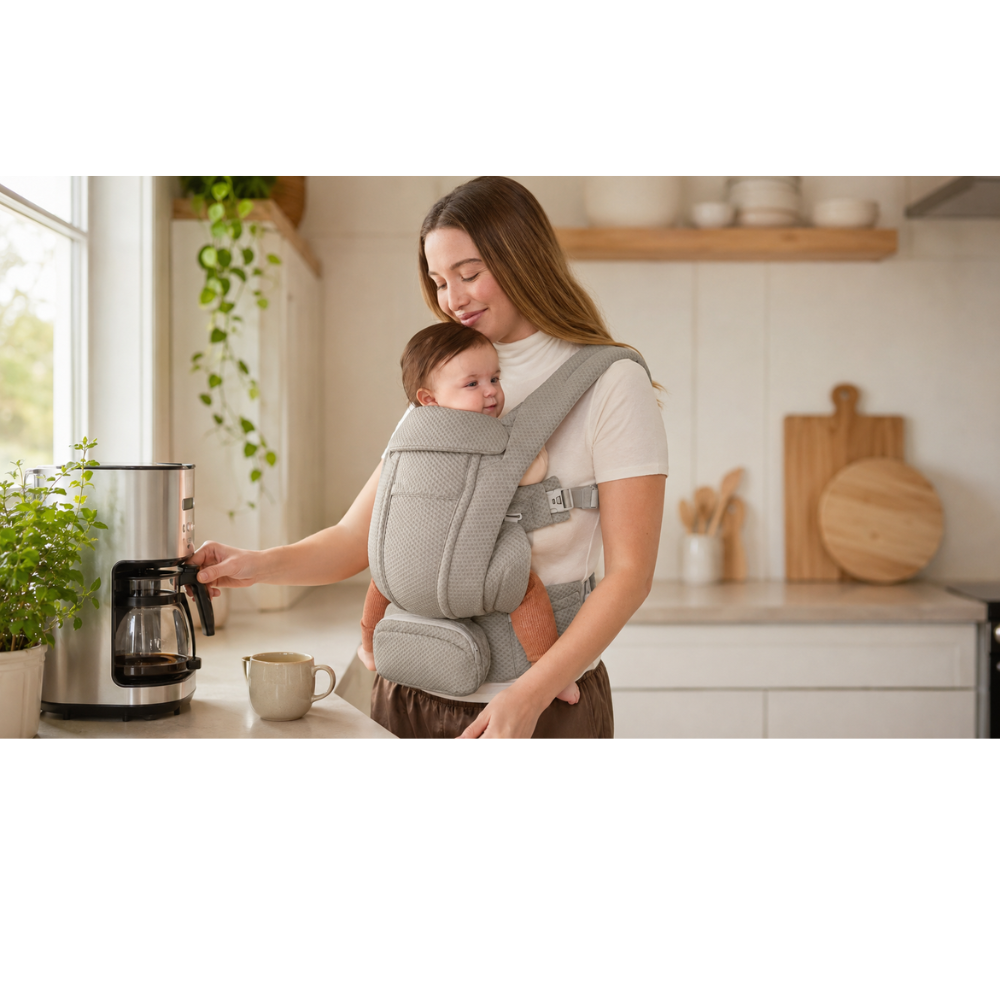
A baby can turn two perfectly capable adult arms into an exhausted delivery system.
The baby wants up. The coffee is over there. An older child has chosen this exact moment to need a shoe tied. Everyone is technically fine, but the geometry is poor.
That is the honest case for a structured carrier. Not “hands-free parenting,” which sounds like a person has escaped the whole arrangement. A carrier simply moves more of the baby's weight onto the adult's shoulders, waist, and torso so closeness does not depend on one aching forearm.
The Ergobaby Omni Deluxe is the big, long-use version of that idea. Ergobaby lists it from 7 to 45 lb and roughly newborn to four years, with front-inward, front-outward, hip, and back carry positions. It also has four storage areas, a privacy hood, adjustable padded straps, lumbar support, and machine-washable fabric.
That is a lot of carrier. The useful question is whether your routine needs it.
Buy for the Years, Not the Feature Count
The Omni Deluxe makes its strongest argument when a family wants one carrier to cover several stages.
A soft newborn carrier may feel easier in the first months. A toddler sling may be faster for quick up-and-down carries. The Omni Deluxe sits between those jobs and tries to keep going: inward-facing newborn walks, later outward-facing carries when the baby is developmentally ready, then hip or back carry after independent sitting.
Those positions are not interchangeable on day one. Ergobaby's instructions tie them to height, weight, head control, and sitting ability. Front outward requires strong, consistent head and neck control. Hip and back carry come later, when the child can sit upright without help. The manual supplied with the carrier—not a social-media demonstration—is the authority for each transition.
If you know you will use a carrier through travel, walks, errands, and toddlerhood, the longer window can justify the cost and the cupboard space. If you only need something soft for the newborn months, all that future capability may feel like wearing a small backpacking system around the house.
The Storage Is More Useful Than It Sounds
Four storage areas are not a grand parenting breakthrough. They are still useful.
On a short walk, pockets can hold a phone, keys, card holder, and one or two small necessities without adding a diaper bag to the shoulders already carrying a child. On a longer outing, they keep the things you reach for most from sinking to the bottom of a larger bag.
That convenience has a limit. Do not pack the carrier until hard objects press into the baby or alter the fit. The pockets are for small essentials, not an attempt to relocate the entire entryway onto your body.
Fit Decides Whether the Padding Works
Padded straps and lumbar support sound reassuring. Poorly adjusted padded straps are still poorly adjusted straps.
The waist belt should sit where the instructions place it for the baby's stage. The shoulder straps should be snug without pulling the baby's body too tightly against yours. The carrier panel should support the child in the specified position, and the baby's weight should feel shared rather than concentrated in the neck, lower back, or one strip of shoulder.
Different bodies will experience the same carrier differently. Torso length, chest size, postpartum recovery, back sensitivity, and caregiver height all matter. Ergobaby says the adjustable fit spans petite through 4XL, which is helpful when caregivers share it, but “adjustable” is not the same as “automatically comfortable.”
Practise at home. Use a mirror or another adult. Learn the buckles while nobody is late.
The Airway Check Is Non-Negotiable
Health Canada's baby carrier guidance uses a memorable CHECK system: chin off chest, have the baby in view, evenly support the back, close enough to kiss, and keep the carrier tight enough to support without obstructing breathing.
In ordinary language:
- keep the baby upright and high on your body
- keep the whole face visible and away from fabric, clothing, and your chest
- make sure the chin is not folded onto the chest
- support the back and neck for the baby's stage
- monitor breathing and overheating often
Babies younger than four months, premature or low-birth-weight babies, and babies with medical or breathing concerns need extra caution and professional guidance before carrier use.
A carrier is also the wrong place for cooking over heat, carrying hot drinks above the baby, driving, sleeping, running, cycling, or any activity with a meaningful fall or burn risk. Bend at the knees, not the waist. Closeness is the benefit; turning the baby into protective equipment is not.
Outward Facing Is an Option, Not a Promotion
Parents sometimes treat outward-facing carry like the level a baby unlocks after inward-facing.
It is simply another position with its own readiness rules and shorter useful windows. The child needs the required head and neck control and enough height for the chin to clear the carrier panel. Some babies enjoy the view. Others become overstimulated or tire quickly.
There is no prize for switching early. Inward-facing remains useful for closeness, sleepiness, busy environments, and easier monitoring. Follow the manufacturer limits and switch the child back when their cues say the outing has become too much.
What the Omni Deluxe Does Well
- covers a broad 7–45 lb manufacturer weight range
- offers four stage-dependent carry positions
- avoids a separate newborn insert
- gives more structure than a soft wrap or newborn carrier
- includes useful pockets and a privacy/sun hood
- adjusts between caregivers and is machine washable
What May Annoy You
- it is bulkier and more expensive than a newborn-only carrier
- the options create a learning curve
- structured carriers can feel warm in hot weather
- the fit still needs re-adjusting between different caregivers
- no carrier makes long wearing comfortable for every adult body
The Decision
Choose the Omni Deluxe if you expect babywearing to remain part of family life beyond the newborn haze and you value one structured carrier with several stage-specific modes.
Choose something simpler if the immediate job is soft newborn closeness, quick toddler pickups, or occasional use. Buying for four years only saves money when the carrier actually suits the bodies, climate, and routines that must use it.
The Ergobaby Omni Deluxe is not effortless. It is capable. Learn the fit, respect the position limits, keep the airway visible, and let it do one believable thing: make carrying a growing child less dependent on your arms conducting a daily endurance test.
Keep reading
Two useful next stops.
2026-07-08
When a Newborn Carrier Actually Makes Life Easier
A practical look at newborn babywearing, safe fit, wrap alternatives, parent comfort, and whether the Ergobaby Embrace solves a real early-months problem.
2026-07-11
Your Toddler Walks Until They Suddenly Don’t
A practical guide to the Ergobaby Upsie Sling for quick toddler pickups, including one-arm support, carry limits, fit, and when a full carrier is better.