SoftNest Journal
When a Newborn Carrier Actually Makes Life Easier
A practical look at newborn babywearing, safe fit, wrap alternatives, parent comfort, and whether the Ergobaby Embrace solves a real early-months problem.
When a Newborn Carrier Actually Makes Life Easier
A newborn can turn an adult into furniture with alarming speed.
The baby wants to be held. Then held again. Then held in the exact position that prevents one arm from doing anything useful. The closeness is real and lovely, and after enough hours it is also hard on shoulders, wrists, backs, and whatever optimism survived the last feed.
That is the honest case for a newborn carrier. It is not a promise that you will glide through early parenthood with two free hands and a tidy kitchen. It is a way to keep the baby close without making your arms responsible for the entire arrangement.
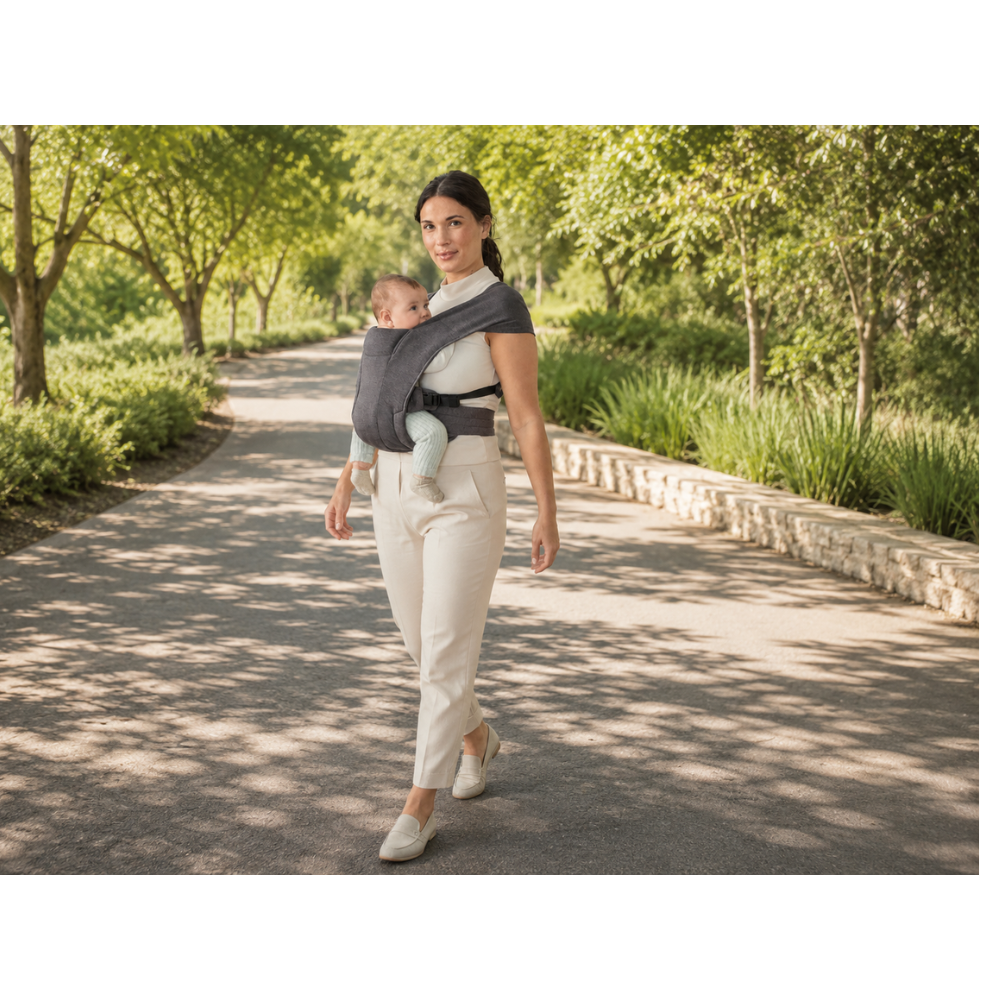
The Ergobaby Embrace Newborn Carrier is built for the first year, with Ergobaby listing it for babies from 7-25 lb and roughly 0-12 months. It offers a soft knit feel, buckle fastening, padded head and neck support, no separate infant insert, and front inward or front outward carrying when the baby is ready. That is a useful set of features if the carrier matches the actual job you need done.
Start With the Problem You Have
Carrier shopping often begins with the wrong question: which one has the most features?
A better question is more ordinary. What is hard right now?
Maybe the baby settles only when held close. Maybe walks would be easier if both hands were not occupied. Maybe a traditional wrap sounds comforting until you imagine learning several metres of fabric while sleep-deprived. Maybe two caregivers need one carrier that adjusts without turning every outing into a workshop.
Those are real problems. A carrier should answer one of them, not simply look reassuring in a registry list.
A Carrier Is Not a Productivity Costume
Babywearing is often sold with a suspicious amount of adult achievement in the background.
The parent is answering emails, preparing food, folding laundry, and perhaps founding a small company, all while the baby rests peacefully against their chest. Real life is less obedient. Wearing a newborn is best for calm, low-risk routines: a walk, a soothing spell, a short errand, or moving gently around the house.
It is not for cooking over heat, drinking hot coffee over the baby, driving, sleeping, or doing anything where a fall, burn, bump, or blocked airway becomes more likely.
The useful gain is modest and important: baby is close, and your arms are not doing every bit of the work.
Why the Embrace Makes Sense If Wraps Intimidate You
A soft wrap has an appealing idea behind it. It can feel snug, flexible, and newborn-friendly. It also asks a tired adult to learn long fabric, tension, placement, and confidence at exactly the stage of life when everyone is already operating on fumes.
The Embrace tries to keep the soft, close feeling while replacing the long wrapping process with buckles. That is the point of this carrier. It is not the most structured all-stage carrier in the world, and it is not trying to be. It is a simpler newborn-focused option for parents who want closeness without a complicated tying routine.
That distinction matters. If the easier setup means the carrier actually gets used, the feature has done its job.
Fit Matters More Than the Feature List
A carrier can have a polished product page and still be wrong if the fit is poor.
The baby should sit high and snug against the adult, with the head close enough to monitor easily. The carrier should support the baby without letting them slump. The fabric should not cover the face or press the chin toward the chest. The baby's weight should feel supported through the adult's body rather than hanging from one miserable patch of shoulder.
Ergobaby lists the Embrace as fitting a wide range of adults, from petite to 4XL. That is useful, especially when more than one caregiver will wear it. Still, adjustment is not theoretical. Try the carrier before relying on it for a long outing. Learn how tight is snug enough. Learn how to remove the baby calmly. Learn it at home, not in a parking lot with a hungry newborn and a diaper bag sliding off your elbow.
Baby Position Is the Safety Test
The safety basics are not decorative advice.
Keep the baby upright, tight enough to be supported, and in view at all times. The face should be visible, the nose and mouth clear, and the chin off the chest. The back should be supported, and the baby should not be curled into a C-shape where breathing can become restricted.
The T.I.C.K.S. rule is a useful shorthand: tight, in view, close enough to kiss, chin off chest, supported back. It is short because parents need something they can remember while tired.
Hip position matters too. A good newborn carry should support the thighs and allow the knees and hips to sit naturally in that bent, spread position often called the M-position. If the baby looks suspended by the crotch or folded oddly, stop and adjust.
Premature babies, low-birth-weight babies, babies with breathing concerns, and babies with medical issues deserve extra caution and professional advice before using a sling or carrier.
Parent Comfort Counts Too
A carrier is not successful if it turns one discomfort into another.
The Embrace is lightweight and soft, which can feel less bulky during the early months than a larger all-stage carrier. The cross-back style may also appeal to parents who want the weight distributed without a heavy frame.
That does not mean every body will love it. Shoulder shape, recovery after birth, chest size, torso length, back sensitivity, and caregiver height all change the experience. Adjust it carefully and stop if wearing it causes sharp pain, numbness, or strain that does not settle with a better fit.
Baby gear should help the routine. It should not ask a recovering parent to quietly suffer because the product looked gentle online.
Know the Limit Before Buying
The Embrace is a newborn carrier with a defined useful window.
That is a strength if you want something soft and simple for the first months. It is a weakness if you hoped to buy one carrier for newborn through toddler life. Once the baby grows past the carrier's stated limits, or once your routine needs back carry, more structure, or longer outings, this may no longer be the right tool.
Families who want a longer-use option may prefer something like the Ergobaby Omni Deluxe, which is designed around more stages and carry positions. That does not make it automatically better. It just solves a different problem.
Buying the Embrace makes the most sense when you are honest about what it is: a first-year carrier, not a forever carrier.
Who Should Consider It
The Ergobaby Embrace is most sensible for parents who want a soft newborn carrier, feel intimidated by traditional wraps, and value a simpler buckle setup. It may also suit caregivers who want something less bulky for walks, soothing, bonding time, and short everyday routines.
I would think twice if you want one carrier to cover toddlerhood, if you need back carry, if you prefer very structured support, or if the baby has medical considerations that require individualized fitting advice.
Before buying, ask:
- Do we mainly need help during the first months?
- Will buckles make us more likely to use the carrier than a wrap?
- Are we willing to practise the fit before relying on it outside?
- Does the weight range and carry-position limit match our plans?
Those questions are less exciting than a feature comparison. They are also more likely to protect you from buying the wrong carrier beautifully.
The Verdict
The Ergobaby Embrace is worth considering when the problem is specific: a newborn wants closeness, the parent wants support, and a full wrap feels like too much fabric for an already full day.
Its strongest case is simplicity. Soft fabric, no infant insert, buckle fastening, and a newborn-focused design make it approachable for early months. Its limit is equally clear: it is not the long-term, multi-position carrier for every stage.
Use it carefully. Keep the baby visible and upright. Practise the fit. Respect the weight and development limits. Then let it do the modest job it was built for.
A good newborn carrier does not make early parenthood effortless. It can make holding a baby for the hundredth time that day feel a little less like a test of endurance. That is enough of a promise to take seriously.
Keep reading
Two useful next stops.
2026-07-08
One Baby Carrier, Four Years: When the Omni Deluxe Makes Sense
A practical look at the Ergobaby Omni Deluxe, its four carry modes, fit and safety limits, and when one long-use carrier earns the extra bulk.
2026-08-23
Starting Solids? What to Know About Using a High Chair Safely and Choosing One That Fits Real Life
A practical guide to when babies are ready for a high chair, which safety features matter most, how to keep cleanup manageable, and whether a convertible model is worth considering.