SoftNest Journal
Starting Solids: 7 Tools That Make Mealtime Easier
A practical, parent-friendly solids setup focused on the tools that actually help with feeding, cleanup, and routine.
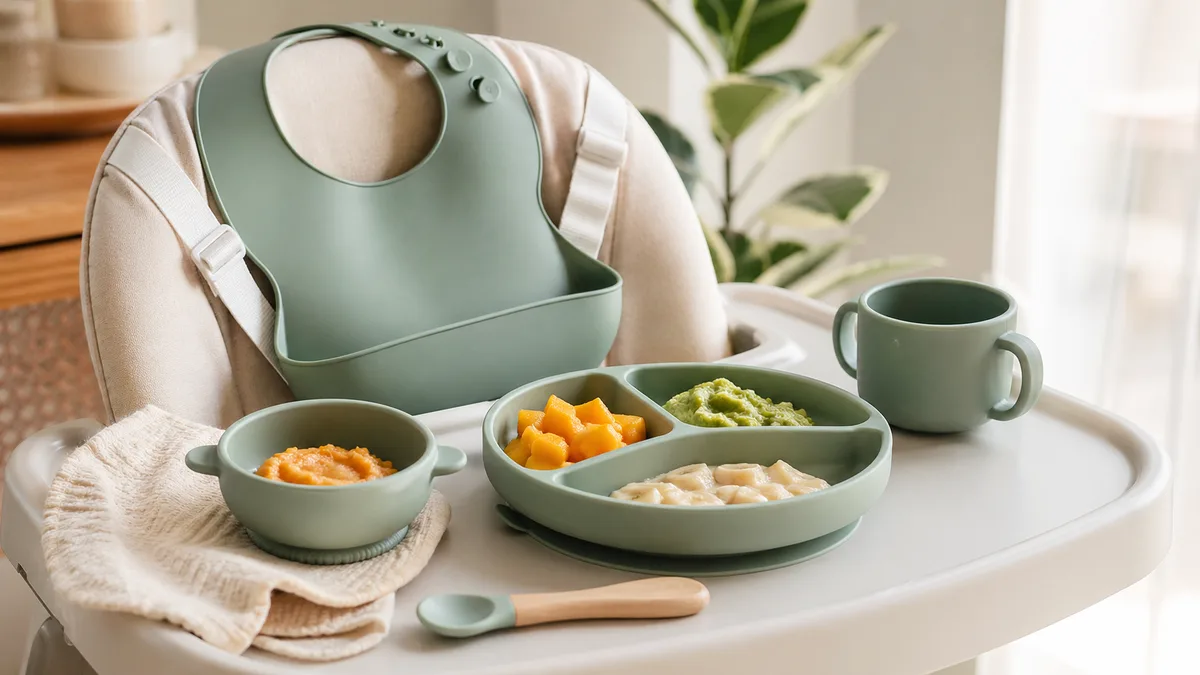
Starting Solids: 7 Tools That Make Mealtime Easier
Starting solids is one of those baby milestones that sounds charming until you are actually in it.
Then it becomes a daily negotiation involving spoons, sleeves, the floor, your own expectations, and a baby who is either delighted by avocado or deeply offended by it depending on the hour.
The good news is that you do not need a mountain of gear to begin. The bad news is that the wrong gear can make the whole stage more annoying than it needs to be.
A practical solids setup should make cleanup easier, support the baby’s learning, and keep the parents from feeling as though every meal has become a kitchen event. Official feeding guidance generally points families toward starting solids around six months, when babies show readiness signs and can sit with support, hold their head up well, and show interest in food. The gear is not the main event. It just helps the routine work.
The First Principle: Buy for Function, Not for Cute Photos
This is where plenty of money disappears.
You do not need a dozen bowls, three novelty cups, and a drawer full of tiny utensils that somehow still fail at the actual job. You need a setup that lets the baby practice and lets you clean up without resentment.
That usually means tools that are easy to wash, easy to grip, and difficult for the baby to fling immediately into orbit.
If you want the simplest place to start, the O'doe 11-Piece Feeding Set is useful because it groups the core pieces together instead of making you buy everything one by one. That alone reduces a surprising amount of decision fatigue.
1. A High Chair You Can Wipe Down Without Muttering
The high chair itself is the real anchor of the setup.
You want a seat that is stable, easy to clean, and practical enough for daily use. Fabric that traps food in the seams is not your friend here. Smooth surfaces and easy access matter more than design language.
What you are looking for is not a high chair with the personality of a luxury lounger. You are looking for one you can wipe in thirty seconds when the banana situation becomes biblical.
2. A Feeding Set That Covers the Basics
This is where the O'doe 11-Piece Feeding Set earns its place. A coordinated set with a suction bowl or plate, baby-friendly utensils, and a cup gives you the basics without forcing you to assemble your own starter kit out of whatever the algorithm suggested at 1 a.m.
That kind of setup helps because it reduces the mental clutter around mealtime. You know what belongs in the chair tray. You know what gets washed afterward. You are not improvising from drawer to drawer.
It also gives the baby a consistent experience, which matters more than people think in the early weeks of solids.
3. A Bib That Covers More Than a Gesture Toward the Problem
The solids stage is where parents learn that not all bibs are serious about the work.
Some are decorative. Some are tiny. Some protect roughly the upper quarter of the child and leave the rest of the outfit to fate.
A better option is the Little Dimsum Long Sleeve Baby Bib, because full coverage is one of the few genuinely useful luxuries in early feeding. If cleanup is easier, you will stay calmer. If you stay calmer, the baby usually does too.
That is not philosophy. That is lunch.
4. A Small Open Cup or Training Cup
Babies do not need a complicated drinkware program to start. They do benefit from practice.
A small cup that is easy to handle is enough to begin introducing the idea. Expect spills. Spills are not evidence of failure. They are the process.
This is another reason a simple feeding set is often better than a collection of random items. Fewer moving parts. Fewer mysteries. Less drawer nonsense.
5. A Reasonable Prep Tool if You Are Making Purées at Home
Not every family makes homemade baby food, and no one should pretend this is a moral ranking. But if you do want to make purées or soft blended foods at home, the GROWNSY 2-in-1 Baby Food Maker is the sort of tool that makes sense because it combines steaming and blending instead of asking you to dirty half the kitchen for carrots.
That is the standard I would use for any food-prep gadget: does it reduce work, or does it just move the work into more parts and accessories?
6. Cloths and Wipes You Can Reach Without Standing Up
This is not glamorous advice, but it is solid advice.
Keep cleanup cloths within arm’s reach at every meal. If you have to stand up repeatedly, the whole feeding experience starts feeling longer and more chaotic. A small towel, wipeable mat, or cloth on standby saves a lot of irritation.
Again, the point is to reduce friction before it has time to become a bad mood.
7. A Sensible Attitude About Mess
This is the least marketable tool and probably the most important one.
Babies learning to eat are not trying to impress anyone. They are touching, smearing, dropping, tasting, and repeating. Some days the mealtime looks productive. Some days it looks like a zucchini was involved in a minor crime.
That does not mean you need more gear. It usually means you need a better cleanup rhythm and lower expectations for visual dignity.
What to Remember About Starting Solids Themselves
The tools matter less than the feeding basics.
Families are generally advised to start solids around six months, when babies are developmentally ready. Iron-rich foods matter early. Common allergens can be introduced as complementary foods, rather than avoided indefinitely, unless a clinician has told you otherwise.
That does not mean you need to transform the kitchen into a test lab. It means solids should begin with attention, patience, and a setup that supports repeated practice.
What I Would Not Buy Right Away
I would not buy a full cabinet of feeding gear before the baby has even started.
I would not assume every mealtime problem can be solved with another bowl shape.
I would not fill the drawer with novelty utensils that are difficult to wash and easy to lose.
And I would not confuse an expensive setup with a useful one.
The Best Solids Setup Is the One You Will Actually Use Every Day
That is the only standard worth much.
If the high chair is easy to wipe, the bib covers enough, the plate stays put, and the prep tools do not create a second round of cleanup, then the setup is doing its job.
If you want to keep it simple, start with the O'doe 11-Piece Feeding Set, add the Little Dimsum Long Sleeve Baby Bib, and only bring in the GROWNSY 2-in-1 Baby Food Maker if homemade prep is actually part of your routine.
That is more than enough to begin.
Keep reading
Two useful next stops.
2026-08-23
Starting Solids? What to Know About Using a High Chair Safely and Choosing One That Fits Real Life
A practical guide to when babies are ready for a high chair, which safety features matter most, how to keep cleanup manageable, and whether a convertible model is worth considering.
2026-03-20
How to Warm Baby Milk Safely Without Turning It Into a Guessing Game
A practical look at bottle warming, safe milk handling, and the small setup changes that make night feeds easier.