SoftNest Journal
At 3 A.M., a Bottle Warmer Only Needs to Do One Job
A clear-eyed guide to the GROWNSY auto-lift bottle warmer: what it changes at night, safe milk handling, real limits, and who can skip it.
A hungry baby has no respect for appliance specifications.
The baby wakes. Somebody finds a bottle. Somebody else may be measuring formula, retrieving expressed milk, changing a diaper, or standing in the kitchen trying to remember whether this is the second wake-up or the fourth.
Three minutes is not a long time in daylight. At 3 a.m., with the crying getting louder, it acquires a management structure.
That is the modest problem a bottle warmer is meant to solve. It does not prepare formula correctly for you. It does not extend the safe life of milk. It does not make the baby sleep longer. It warms a bottle in a repeatable way so a tired adult can stop improvising with a bowl and a tap.
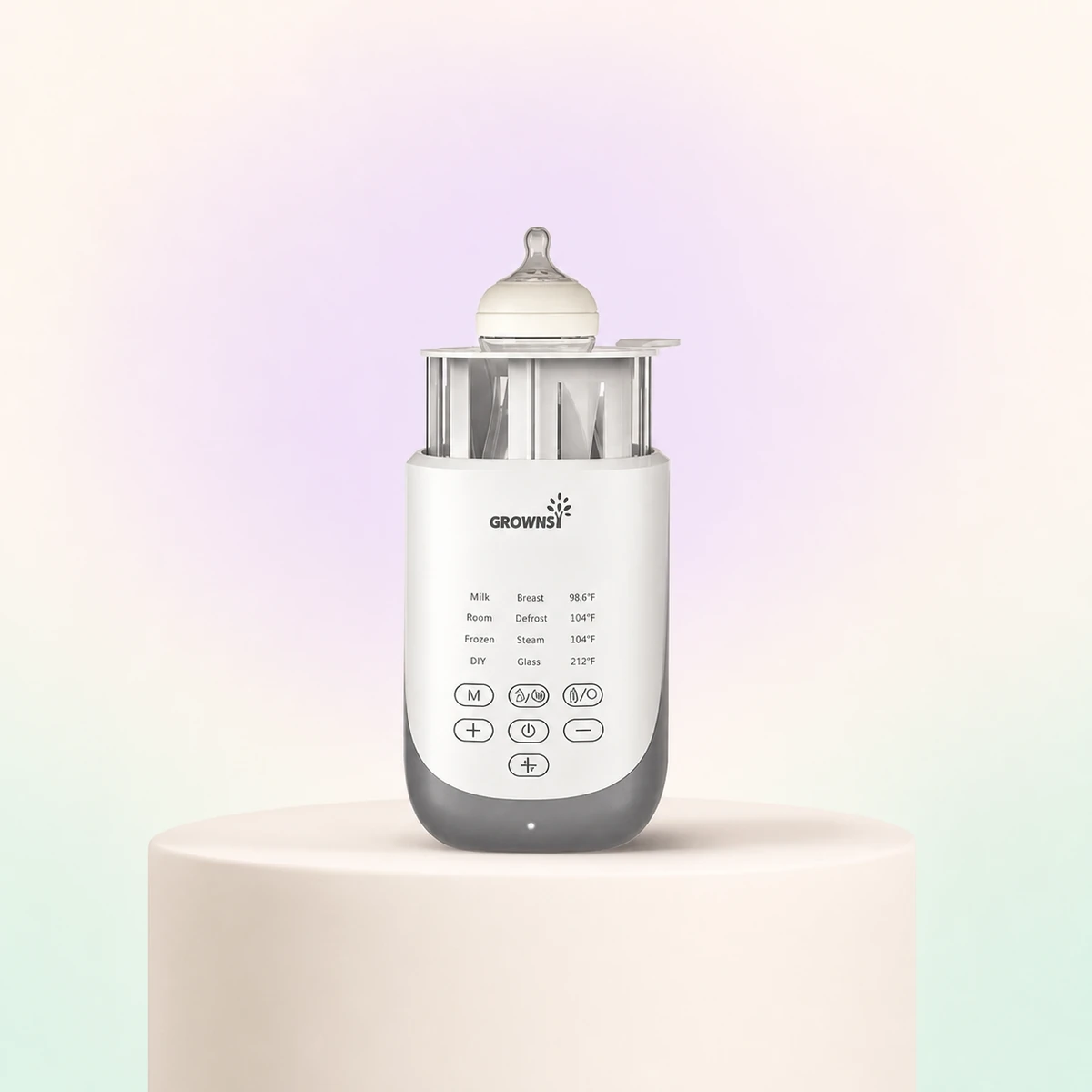
The GROWNSY 10-in-1 Bottle Warmer adds an auto-lift mechanism: when the warming cycle ends, the bottle rises out of the water bath instead of continuing to sit in it.
That feature is either useful or completely unnecessary. The answer depends less on the number ten and more on what actually happens in your kitchen at night.
First, the Bottle Does Not Need to Be Warm
This is the part warmer advertisements tend to walk past briskly.
Infant formula and expressed breast milk do not have to be served warm. When the milk has been prepared and stored safely, it may be offered cold, at room temperature, or gently warmed. Some babies accept any temperature. Some develop a preference and enforce it with considerable confidence.
If your baby drinks a cold bottle happily, you have already solved the problem. Do not buy an appliance to reintroduce it.
A warmer becomes relevant when:
- the baby consistently prefers warm milk
- much of the milk comes from the refrigerator
- several caregivers need one repeatable method
- night feeds involve too much checking, waiting, or reheating
- a bowl of warm water works but has become one more loose step in an already loose routine
This is convenience, not a feeding requirement. That distinction keeps the decision honest.
What the Auto-Lift Actually Changes
Most bottle warmers use a heated water bath. The adult places the bottle inside, chooses a setting, waits, and removes it.
The GROWNSY model adds a small mechanical conclusion. At the end of the selected cycle, the bottle is raised above the heated water. The point is not spectacle. The point is to reduce continued warming when the adult is changing a diaper, washing a hand, or discovering that the clean burp cloth has once again left the premises.
Auto-lift does not prove that the milk is ready to feed.
Bottle material, shape, milk volume, starting temperature, room temperature, and the selected mode can all change the result. GROWNSY advertises feed-ready warming in under three minutes under suitable conditions, while its detailed product material gives a broader two-to-five-minute range for four ounces. Treat the timing as a manufacturer estimate, not an appointment.
The useful routine remains:
- Use the setting that matches the bottle, amount, and starting temperature.
- Let the cycle finish.
- Gently mix the milk as appropriate so the temperature is even.
- Test a few drops before feeding.
The machine can lift the bottle. It cannot inspect the bottle.
Ten Functions Are Not Ten Reasons to Buy It
The warmer includes modes or features for fast warming, defrosting, keeping warm, steaming, heating baby food, timing, memory, nighttime use, and the auto-lift system.
This sounds impressive because ten is an impressive number when printed beside a product.
Most families will probably use two or three functions regularly. That is fine. An appliance does not become a poor purchase because seven buttons lead quiet private lives.
The question is whether the functions you will use remove repeated work:
- Fast warming matters if refrigerated bottles are common.
- Memory can help when the same bottle and volume appear every night.
- Auto-lift can help when the end of a warming cycle is easy to miss.
- Defrosting may matter for families using frozen expressed milk, provided the milk-handling guidance is followed.
- Food warming may give the appliance a second job when solids begin.
Steam and keep-warm modes deserve more care. Use them only for the purposes and time limits in the product instructions. A feature name is not permission to steam every feeding item or keep prepared milk warm indefinitely.
“Keep Warm” Does Not Pause Food Safety
This is the largest trap in the category.
The product is advertised with extended warming capability. That does not mean a prepared bottle of formula or warmed breast milk can sit there for the night. Warm milk is still perishable milk.
Formula has preparation, room-temperature, refrigeration, and after-feeding limits. Expressed breast milk has its own storage, thawing, warming, and leftover limits. Those limits do not become optional because an appliance can maintain a temperature.
If the manual allows water to be kept ready for a later step, read exactly what that mode is intended to hold. Do not assume “24-hour warm” means “24-hour prepared bottle.” It does not.
The safer habit is dull and effective:
- prepare or retrieve the milk according to current guidance
- warm only the bottle you are about to offer
- use it within the applicable time limit
- discard leftovers when required
There is no clever setting that makes old milk younger.
Warming Formula Is Not Preparing Formula
A warmer begins after the formula has been prepared correctly. It cannot repair an incorrect water-to-powder ratio, unsafe water, an unclean bottle, or a preparation method that does not suit the baby's health needs.
Follow the exact directions on the formula container and the current advice of the baby's healthcare team or health authority. Measure the water and powder exactly as directed. Never add extra water to stretch a container and never add extra powder in the hope of producing a more substantial night.
Powdered infant formula is not sterile. Babies who are very young, were born prematurely, or have a weakened immune system may require additional precautions or a different form of formula. That decision belongs with current health guidance, not the warmer's control panel.
Once the formula is prepared, it does not need to be warmed unless the baby prefers it that way. If you warm it, do not use a microwave. Uneven microwave heating can create hot spots even when the bottle feels ordinary from the outside.
The warmer changes temperature. It does not change the preparation rules.
Breast Milk Needs Gentle Handling, Not Ceremony
Expressed breast milk can also be offered cold or at room temperature. If you choose to warm it, keep the container closed and use a gentle method approved by the warmer and the milk-storage guidance you follow.
After warming, swirl the milk to mix separated fat rather than treating the bottle like a cocktail shaker. Test the temperature before feeding. Do not heat breast milk directly on a stove or in a microwave.
Previously frozen milk has thawing and use limits. Milk that has been warmed has a use limit. Milk left after a feed has another limit because the baby's saliva has entered the bottle.
Write the current rules where every caregiver can find them. A small note inside a cupboard is more useful at night than one person's confident memory of a chart seen six months ago.
For the broader feeding plan—breastfeeding, pumping, formula, or a combination—read Breast Milk, Formula, or Both? Build a Feeding Plan That Works.
Build the Night Feed Before the Baby Wakes
The best improvement may have nothing to do with heating speed.
A useful night setup removes decisions without taking shortcuts with milk safety. Before bed, make sure:
- clean bottles and nipples are dry and easy to reach
- the warmer is clean, descaled when required, and sitting on a stable dry surface
- the correct measuring item and formula instructions are available if formula is used
- expressed milk is labelled and stored correctly
- a dim light, burp cloth, and feeding chair are ready
- every caregiver knows which milk is being used and what must happen next
Do not place a hot-water appliance on a soft surface, crowded bedside table, floor, or unstable trolley. Keep the cord and unit out of a child's reach. Follow the fill line and cleaning directions for the exact model.
Most importantly, do not fill, empty, move, or handle a hot warmer while holding or wearing the baby. Put the baby somewhere safe or ask another adult to handle one side of the operation. A calm-looking appliance still contains hot water and electricity.
The cover photograph can be peaceful. The working routine should be sensible.
The Cleaning Question Arrives Quickly
Any appliance that repeatedly heats water will develop mineral buildup. How quickly depends on the water and frequency of use.
Descaling is not a decorative maintenance project. Buildup can affect heating performance and turn a quick routine into an increasingly inaccurate one. Empty and clean the unit as the instructions require, and let it dry rather than maintaining a permanent little indoor pond.
Before buying, ask:
- Can the water reservoir be reached easily?
- Will you actually descale it?
- Is there a stable place for it near an outlet?
- Can it stay away from the sink edge, heat sources, and small hands?
- Does your bottle shape fit without awkward improvisation?
Counter space is part of the price. So is the willingness to clean the thing.
What the GROWNSY Does Well
The GROWNSY design makes sense for a household that warms bottles often and wants a more structured end to the cycle.
Its strongest points are:
- the bottle physically lifts out of the water after warming
- the same routine can be repeated by different caregivers
- memory and low-light features suit night use
- it accommodates several bottle materials and shapes according to the manufacturer
- defrost and food-warming modes may remain useful beyond one feeding stage
The advertised dual temperature sensors and precise control are product claims, not a reason to stop checking the bottle. The practical advantage is consistency, not clairvoyance.
What It Cannot Fix
It cannot:
- make formula preparation automatic
- extend the safe holding time of prepared milk
- guarantee the same warming time for every bottle
- eliminate temperature testing
- become portable without power
- free you from cleaning and descaling
- persuade a baby to sleep after the feed
It also cannot justify itself if the baby accepts cold milk and the existing routine already works.
Baby products often promise to transform family life. This one has a narrower opportunity. It may improve several minutes that happen several times a day. Repetition can make a narrow improvement valuable.
Who Should Consider It
The GROWNSY auto-lift warmer is easiest to justify when:
- bottles are used daily
- refrigerated expressed milk or prepared formula is common
- the baby prefers warm feeds
- more than one caregiver prepares bottles
- the current water-bath routine involves repeated checking
- the warmer will have a safe permanent place and be cleaned regularly
You can probably skip it when:
- the baby drinks cold or room-temperature milk
- bottles are occasional
- counter space is already a diplomatic dispute
- you mainly need something for travel
- a bowl of warm water is already quick and consistent
- the extra modes will exist only as a source of guilt
There is no prize for owning the more elaborate feeding station.
The Decision
The GROWNSY 10-in-1 Bottle Warmer is not essential. Its auto-lift is genuinely different from the usual warm-and-wait design, and that difference can be useful when night feeds are frequent and a bottle often remains in the water longer than intended.
Buy it for the routine, not the feature count.
If your household warms several bottles a day, values a repeatable method, and will use the auto-lift, the appliance may remove a small but persistent aggravation. If the baby accepts cold milk or bottles appear only occasionally, keep the counter space and use warm water when needed.
At 3 a.m., the best product is not the one that claims to understand parenthood.
It is the one that finishes its small job without creating a new one.
This article may contain affiliate links. SoftNestStyle may earn a small commission from qualifying purchases at no additional cost to you.
Health and safety note: This article provides general education, not individualized medical care. Formula preparation, milk-storage limits, water safety, and recommendations for babies born prematurely or with medical risks can differ by product and location; follow the exact formula label, bottle-warmer manual, healthcare-team advice, and current health-authority guidance where you live. Bottle-warming and handling guidance was checked against the CDC infant-formula preparation and storage guidance and CDC breast-milk storage and preparation guidance. Never microwave a baby bottle, and seek professional advice when feeding or milk safety is uncertain.
Keep reading
Two useful next stops.
2026-03-20
How to Warm Baby Milk Safely Without Turning It Into a Guessing Game
A practical look at bottle warming, safe milk handling, and the small setup changes that make night feeds easier.
2026-07-04
What a Smart Baby Monitor Is Actually Good For
A grounded look at smart-monitor video, alerts, sleep insights, privacy, and whether the Momcozy BM08 solves a real problem in your nursery.