SoftNest Journal
Newborn Safe Sleep: Check These Four Things Every Time
A globally useful safe-sleep guide covering back sleeping, firm flat surfaces, clear sleep spaces, room-sharing, swaddling, overheating, travel and tired nights.
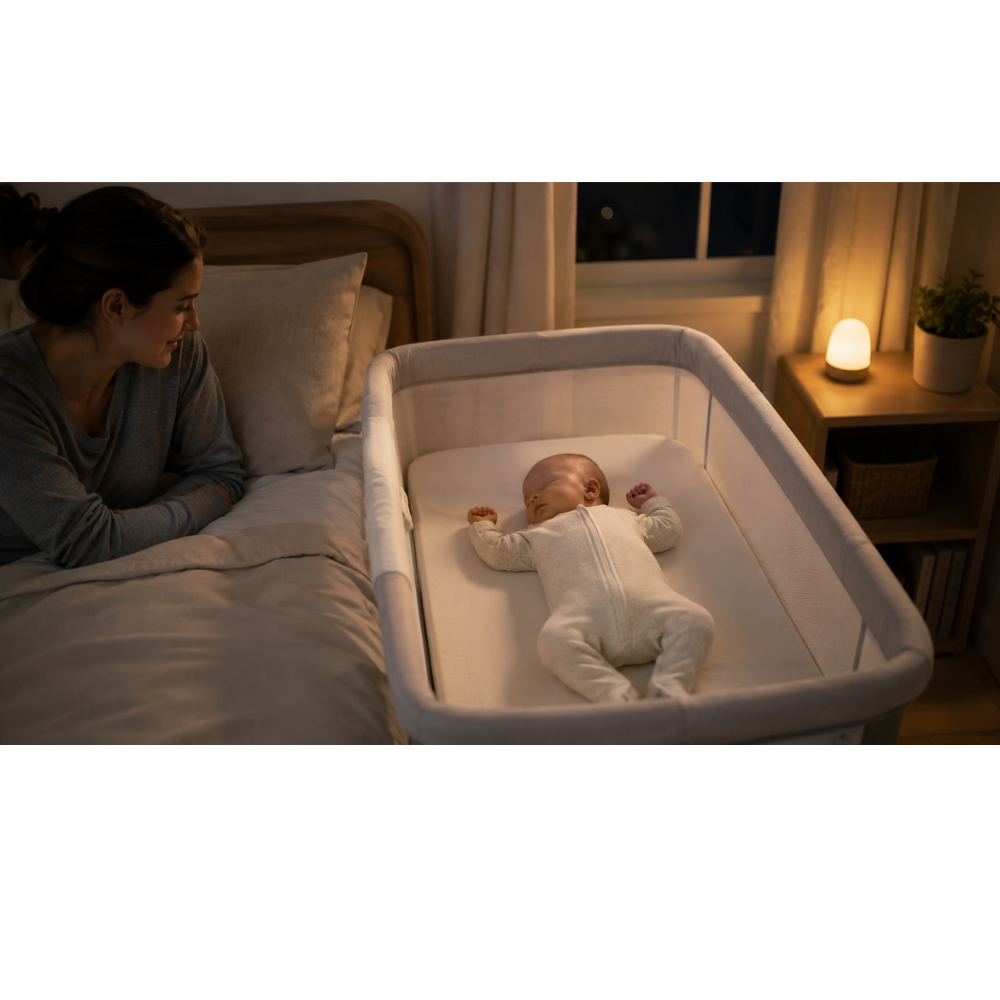
It is 2:17 a.m. The feed is finished. The baby is warm and heavy against your chest, and the bassinet looks almost comically empty.
That emptiness is the point.
For every nap and every night, check four things:
- Back: place the baby on their back to begin the sleep.
- Surface: use a firm, flat mattress in an infant sleep product approved under the current safety rules where you live.
- Space: keep the sleep space clear except for a tightly fitted sheet.
- Location: keep the baby's separate sleep space in the caregiver's room for the first six months and away from cords, windows, heaters, and other hazards.
These steps lower the risk of sleep-related infant death. They do not guarantee that Sudden Infant Death Syndrome, or SIDS, can be prevented, and they do not promise longer sleep. Safe sleep is a risk-reduction practice, not a sleep-training method and not a judgment on how tired a family feels.
The Sixty-Second Reset
Before lowering the baby into the sleep space, pause long enough to scan it.
- Is the baby going down on their back?
- Is the mattress firm, flat, level, and fitted to this product?
- Is the fitted sheet the only item on the surface?
- Is the baby's face uncovered?
- Is the sleepwear fitted and appropriate for the room?
- Are monitor cords, blind cords, furniture, wall decor, and heaters out of reach?
- Is the product still being used within its current height, weight, and developmental limits?
This check matters after laundry, visitors, travel, and the arrival of a well-intentioned gift. A crib can begin the day empty and acquire a blanket, burp cloth, toy, nursing pillow, and decorative cushion by bedtime. Soft objects are social creatures.
Clear the space again.
Place the Baby on Their Back for Every Sleep
Back sleeping applies at night, during naps, at home, in childcare, and while travelling. Side positioning is unstable; a newborn placed on their side can roll toward the stomach before having the strength or coordination to correct the position.
Do not use rolled towels, wedges, nests, pillows, or positioners to keep the baby in place. A product that promises to hold a sleeping position adds material beside the baby's face and does not replace the back-sleeping recommendation.
When the baby can roll over independently, continue placing them on their back at the start of every sleep. Current safe-sleep guidance generally says that if they then roll onto their side or stomach on their own, you do not need to keep turning them back. Confirm the recommendation with the health authority where you live, keep the space clear so the baby has room to move, and stop swaddling before rolling begins.
If a healthcare professional gives a different position for a specific medical reason, ask for exact written instructions: which position, which sleep surface, for how long, and whether the plan applies to every caregiver. A vague memory of advice is not enough for a safety exception.
Use a Sleep Space Approved Where You Live
Product names and safety categories differ around the world. Choose a crib, cot, cradle, bassinet, Moses basket, or portable infant sleep product only if the product-safety and health authorities where you live recognize that exact type and model for unattended infant sleep. Use it according to its instructions.
The surface should be:
- firm enough that the baby does not sink into it
- flat and level, not inclined
- fitted tightly to the frame with no trapping gaps
- covered only by a tightly fitted sheet made for that mattress
- unmodified
Use the mattress supplied for the product or the exact replacement the manufacturer permits. Do not add a second mattress, foam topper, folded blanket, padded liner, or homemade insert. Softer does not mean safer for an infant who cannot lift or reposition the head reliably.
The word “bassinet,” “cot,” or “sleeper” on a listing is not the entire decision. Confirm that the actual model meets current requirements where you live, has all its parts, has not been recalled locally, and is being used within its limits. Stop using it at the earliest limit in the instructions, which may involve weight, height, age, pushing up, or rolling.
Portable cots, play yards, playpens, and their bassinet attachments are classified differently across countries. Approval of one attachment or level does not prove that every part is intended for unattended sleep. Check the instructions for the exact model and the current rules where you live instead of assuming every flat-looking level has the same purpose.
Keep the Sleep Surface Properly Empty
An infant sleep space does not need:
- pillows or infant pillows
- quilts, duvets, comforters, or loose blankets
- bumper pads or mesh liners
- stuffed toys
- nursing or pregnancy pillows
- baby nests, pods, or loungers
- head-shaping pillows
- sleep or anti-roll positioners
- wedges or inclined inserts
- bibs, necklaces, headbands, or hats
- bottles, clips, cords, or pacifiers attached to long straps
These items can obstruct breathing, trap the baby, cover the face, or contribute to overheating. Remove them rather than arranging them farther from the baby's head. A newborn can move in ways that do not look purposeful and still reach something that appeared safely distant.
Do not drape a blanket over a crib or bassinet to darken it. Fabric can fall, reduce airflow, increase heat, or create a strangulation hazard. Use the room—lights, curtains installed safely away from the sleep space, and ordinary household sound—to shape the environment.
The room may be decorated. The mattress should remain boring.
Room-Share Without Sharing the Sleep Surface
Place the crib, cradle, or bassinet in the parent or caregiver's bedroom for the first six months. Room-sharing keeps the baby nearby for feeding and observation while preserving a separate surface designed for infant sleep.
Bed-sharing is different. An adult mattress, pillows, duvets, gaps, headboards, other people, and pets create risks that an approved infant sleep space is designed to avoid. Bed-sharing increases the risk of SIDS, suffocation, entrapment, overheating, and falls.
The risk is especially high when:
- the baby is younger than four months
- the baby was born prematurely or at a low birth weight
- anyone smoked during pregnancy or the baby is exposed to smoke
- an adult has used alcohol, cannabis, recreational drugs, or medication that causes drowsiness
- the adult is extremely tired or difficult to wake
- another child or a pet shares the surface
- the surface is a sofa, armchair, recliner, waterbed, air mattress, futon, or has memory foam or extra padding
- pillows, duvets, loose sheets, gaps, or soft objects are near the baby
The safest plan is to feed or comfort the baby, then return them to the separate sleep space before the caregiver sleeps.
Keep the Baby's Air Smoke- and Vapour-Free
Exposure to tobacco smoke before and after birth increases the risk of SIDS. Protect the baby from cannabis smoke and second-hand vapour as well. Make the home and vehicle smoke- and vape-free; an open window or a different room does not remove the exposure.
If a parent or caregiver smokes or vapes, support to quit or reduce exposure is part of the safety plan, not a reason to hide the subject from a healthcare professional. Change smoke-exposed outer clothing and wash hands before handling the baby, while recognizing that these steps do not make indoor smoke safe.
Breastfeeding is associated with a lower risk of SIDS, but safe sleep is not conditional on feeding method. A baby who receives formula, expressed milk, breast milk, or a combination needs the same back position, clear approved sleep space, and smoke-free environment.
Plan for the Feed During Which You Might Doze
Exhaustion deserves a plan, not a lecture.
Before the night begins, put water, feeding supplies, a phone, and a dim light within reach of a safe feeding position. If another capable adult is available, agree on what “I am fading” means and who will take over.
Never choose a sofa, armchair, or recliner because you are trying not to fall asleep in bed. Falling asleep with a baby on a cushioned seat is particularly dangerous because the baby can become trapped against the adult or cushions.
If you think you may unintentionally doze while feeding in an adult bed, remove pillows, duvets, loose bedding, pets, and other people from the baby's area before the feed. Keep the baby away from walls, headboards, and gaps. As soon as you wake, return the baby to the crib, cradle, or bassinet.
This is harm reduction for an unplanned event. It does not make an adult bed an approved infant sleep space, and it does not remove the extra risks listed above. Discuss recurring bed-sharing and your family's specific risk factors with a healthcare professional who can give nonjudgmental, individualized advice.
If one adult is so exhausted, unwell, or affected by a substance or medication that waking reliably is doubtful, that adult should not be the only person handling the baby overnight.
Dress for the Room, Not for the Fear of Cold
Overheating is a risk factor for SIDS. Dress the baby in simple, fitted sleepwear appropriate for the room. If the room feels comfortable to a lightly dressed adult, begin there rather than adding layers until the baby's hands feel warm.
Hands and feet can feel cooler than the baby's chest or back. Check the torso. Sweating, damp hair, flushed skin, a hot chest, or rapid breathing can be signs that the baby is too warm. Remove a layer and assess the baby; seek medical advice if breathing or behaviour is concerning.
For sleep:
- remove outdoor clothing after coming inside
- do not use an indoor hat
- remove bibs, jewellery, hooded clothing, and garments with unsafe ties or loose parts
- choose well-fitting sleepwear that cannot ride over the face
- use a correctly sized sleep sack if desired, without adding a blanket
- keep the head and face fully visible
Avoid weighted sleep sacks, weighted swaddles, and weighted blankets. Weight is not a substitute for a caregiver's hand, and infant-safety authorities advise against these products for babies.
Swaddling Is Optional and Temporary
A newborn does not need to be swaddled to sleep safely. Some babies settle with it; others communicate a firm preference for having their hands available.
If you swaddle:
- place the baby on their back
- keep the fabric away from the mouth and nose
- wrap the chest securely enough that fabric cannot come loose, but not so tightly that breathing is restricted
- leave room for the hips and legs to bend and move
- use light material appropriate for the room
- put the baby in the empty crib, cradle, or bassinet
Stop at the first signs that the baby is trying to roll, before a successful roll happens in the middle of the night. Age-based advice can vary, so check the current recommendation where you live and stop earlier if the baby's development or product instructions require it.
Do not swaddle a baby who is bed-sharing. Do not use a weighted swaddle. Do not place a swaddled baby on the side or stomach. If the baby repeatedly escapes the wrap or fabric reaches the face, stop and use suitable fitted sleepwear instead.
Every caregiver needs to know when swaddling has ended. A grandparent working from last week's instructions should not reintroduce it during a nap.
Swings, Bouncers, Car Seats, and Strollers Have Other Jobs
Products that hold a baby upright, semi-upright, seated, or inclined are not routine sleep spaces. In those positions, a young baby's head can fall forward and interfere with breathing.
If the baby falls asleep in a swing, bouncer, high chair, or other inclined product, move them to the crib, cradle, or bassinet as soon as possible. Supervision does not convert a seat into a flat sleep surface.
A car seat is essential for safe travel in a vehicle. During the trip, use it exactly as directed, with the harness fitted correctly. Once you reach the destination, move the sleeping baby to an approved sleep space rather than carrying the seat inside as the night's bassinet.
The same principle applies to a stroller. Travel use and unattended sleep are different purposes. Follow the exact instructions for any stroller bassinet; the fact that one component reclines flat does not prove that it meets infant-sleep requirements where you live.
In a sling or carrier, keep the baby's face visible, the chin off the chest, and the airway clear. A sleeping baby should be transferred to the appropriate separate sleep space when possible. Never zip a coat over the baby's head or face.
Travel Needs a Sleep Plan Before Arrival
“The hotel has a crib” is a beginning, not a specification.
Before travelling, ask what product will be supplied and whether a fitted sheet is included. On arrival:
- check the model, assembly, mattress fit, and visible condition
- confirm that all required parts are present
- remove added pillows, blankets, liners, and toys
- place it away from blind cords, windows, heaters, lamps, and unstable furniture
- check current recall information if there is any uncertainty
- use it within the manufacturer's limits
Do not improvise a sleep surface from couch cushions, a suitcase, a padded chair, a drawer, an adult bed, or a nest on the floor. If suitable infant sleep equipment cannot be confirmed, solve that problem before the baby needs to sleep.
Share the same rules with relatives and childcare providers. Safe sleep does not take a holiday because the fitted sheet has tiny moose on it.
Positioning Does Not Treat Reflux
Spit-up is common and can make back sleeping feel counterintuitive. For most babies, the back remains the recommended sleep position. Do not raise one end of the mattress, add a wedge, place the baby on the side, or use an inclined sleeper to treat reflux unless a qualified healthcare professional has given a specific plan for the individual baby.
An inclined or propped surface can let the baby slide into a position that obstructs breathing. Products marketed for reflux, head shape, or “comfort” do not overrule current safe-sleep guidance.
Ask for medical advice if vomiting is forceful, green, bloody, frequent and concerning, associated with poor feeding or poor growth, or accompanied by pain, breathing difficulty, unusual sleepiness, fewer wet diapers, fever, or another change that worries you.
A Monitor Watches the Setup; It Does Not Repair It
A video or audio monitor can help a caregiver hear or see a baby in another room. It cannot make a soft, inclined, shared, or cluttered sleep surface safe.
Consumer heart-rate, oxygen, breathing, or movement monitors are not substitutes for medical equipment, safe-sleep practices, or checking an unwell baby. A reassuring number should never delay care for a baby who looks blue or grey, is struggling to breathe, is limp, or is difficult to wake.
Install every monitor exactly as directed. Keep cords and the device itself well beyond reach. Recheck the distance as the baby grows and the crib mattress is lowered. A cord that was inaccessible to a newborn may become interesting to a mobile infant.
If a medical team prescribes monitoring, follow that team's equipment, alarm, and response plan. That is a different situation from buying a consumer monitor for reassurance.
Give Every Caregiver the Same Four-Line Script
Do not hand over a thirty-item list at the nursery door. Use a short instruction that can survive a tired afternoon:
- Put the baby down on their back.
- Use this crib, cradle, or bassinet with only this fitted sheet.
- Use this sleepwear; do not add blankets, pillows, toys, positioners, or a hat.
- If the baby falls asleep anywhere else, transfer them here.
Then add the baby's current limits:
- swaddling has stopped, or exactly how it is used
- the bassinet remains within its limits, or the baby has moved to the crib
- who to call for a feeding, temperature, breathing, or illness concern
- which adult takes over if the caregiver becomes too tired
Show, do not merely tell. Let the caregiver place the baby in the sleep space while you are present. Correcting the setup before the first solo nap is kinder than discovering a decorative quilt in a photograph later.
Normal Newborn Sleep Can Still Feel Chaotic
Newborns wake frequently. Day and night may appear to be suggestions. A baby can wake soon after transfer, feed often, grunt, stir, and require repeated settling without the sleep space being wrong.
Do not solve ordinary waking by making the surface softer, adding a positioner, leaving the baby in a swing, or bringing loose bedding into the crib. Those changes may make the photograph look cozy while adding risk.
Instead:
- take turns with another capable adult when possible
- keep feeding and changing supplies organized
- use a brief, repeatable wind-down
- reduce light and stimulation overnight
- ask for feeding or medical support when waking is paired with pain, poor intake, breathing concerns, or poor growth
- protect the caregiver from driving or handling the baby when dangerously sleepy
Safe sleep answers where and how the baby sleeps. It does not promise when the baby will sleep through the night.
Know Which Changes Need Medical Help
Contact a healthcare professional promptly if a newborn becomes unusually hard to wake, feeds poorly, has fewer wet diapers, vomits repeatedly, appears to be in pain, or has a major change in breathing, colour, tone, or behaviour.
A baby younger than three months with a fever needs urgent medical assessment. Use the temperature method and threshold advised by the baby's healthcare team or local health service; touching the forehead is not an accurate measurement.
Call emergency services if the baby:
- has severe difficulty breathing
- has blue, grey, or very pale lips or skin
- is limp, unresponsive, or cannot be awakened
- has a seizure
- may be choking or has another life-threatening symptom
Do not wait for a monitor alarm or search for a better article when a baby may be seriously unwell.
The Checklist Beside the Crib
For every sleep:
- back to start
- firm, flat, level mattress
- locally approved infant sleep product used within its limits
- tightly fitted sheet only
- clear face and bare head
- fitted sleepwear suitable for the room
- no loose or soft objects
- no smoke, cannabis smoke, or vapour exposure
- caregiver's room for the first six months
- cords, windows, heaters, decor, and furniture out of reach
- transfer from seats, swings, carriers, and other non-sleep products
For the household:
- read the product instructions before the exhausted night
- check recalls and condition, especially for second-hand or travel equipment
- stop swaddling before rolling
- decide who takes over when a caregiver is fading
- teach every caregiver the same setup
- keep urgent phone numbers easy to find
That is the whole visual: a baby on their back, in simple sleepwear, on a firm flat mattress, in a clear separate space nearby.
The bassinet may look empty. It is not missing comfort. The comfort is the familiar voice, the feed, the clean diaper, the hand on the chest while the caregiver is awake—and then a sleep surface with nothing left to rearrange.
Health and safety note: This article provides general education and cannot assess an individual baby or replace advice from qualified healthcare professionals where you live. Safe-sleep recommendations, product approvals, recall systems, urgent-care pathways, and emergency numbers vary by location and can change. Follow the current guidance of your local health and product-safety authorities, the baby's healthcare plan, product instructions, and local recall notices. Contact local urgent or emergency services whenever a newborn may be seriously unwell.
Keep reading
Two useful next stops.
2026-02-08
A Practical Newborn Sleep Setup (Without Overbuying)
A grounded guide to building a safe, calm newborn sleep setup without filling the nursery with unnecessary gear.
2026-06-16
A Bedside Bassinet Can Make Newborn Nights Easier—If It Fits Your Setup
A practical guide to bedside bassinets, safe setup, height and wheel checks, and whether the GROWNSY 5-in-1 belongs in your nighttime routine.