SoftNest Journal
A Dual-Motion Baby Swing Can Rest Your Arms—Not Replace a Crib
A clear-eyed guide to the GROWNSY dual-motion baby swing: where it may help during supervised awake time, where it cannot, and how to use it safely.
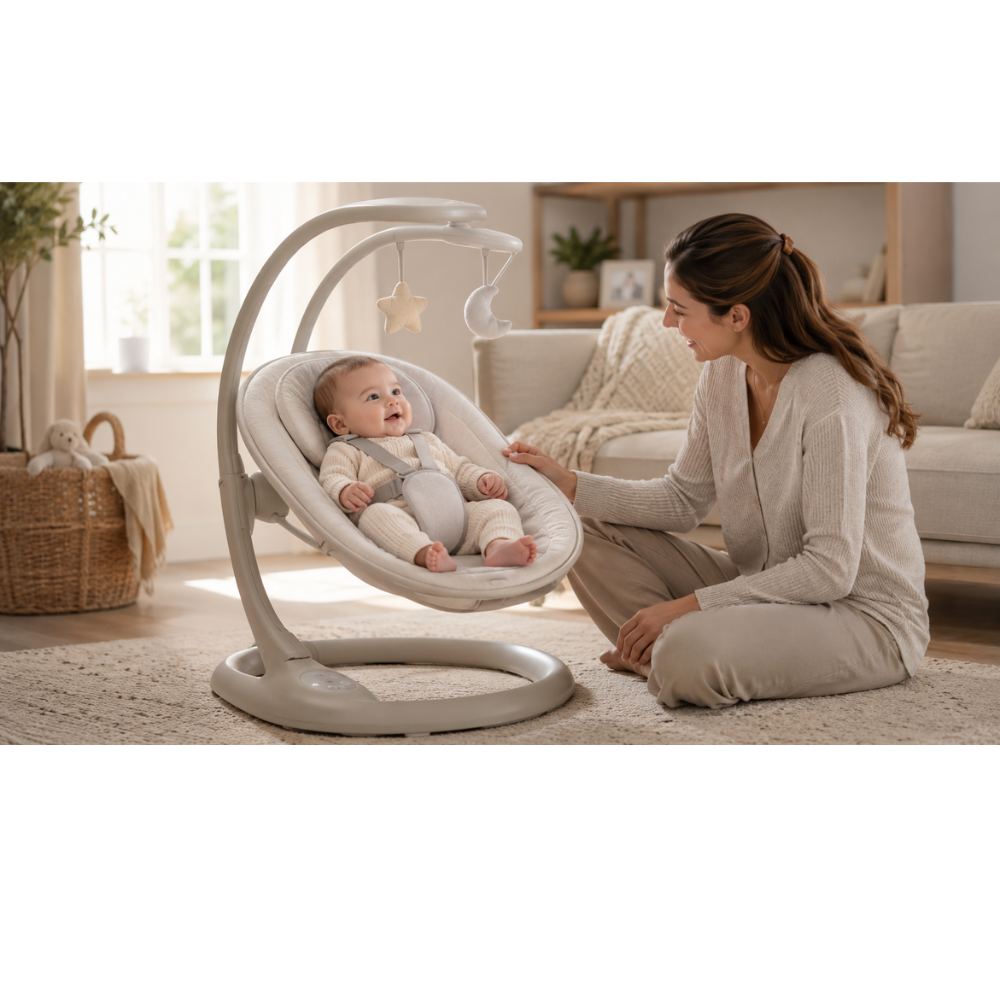
A baby can reject a perfectly good seat with the conviction of a restaurant critic.
You fasten the harness. You choose the gentlest motion. You sit close enough to make eye contact. The baby studies the arrangement for four seconds and announces that your arms were better.
This does not mean the seat is defective. It means the customer is a baby.
A swing is best understood as one more place for an awake baby to spend a short, supervised stretch—not a machine that solves crying and certainly not a place to sleep. The GROWNSY Dual-Motion Baby Swing makes that limited job more flexible by moving side to side or front to back. One direction may suit a baby who dislikes the other. Both may be rejected before lunch.
That is the honest purchase decision. The swing may rest your arms, buy a few calm minutes, or give the baby a different view of the room. It cannot replace holding, feeding, floor play, human attention, or a proper sleep space.
Begin With the Actual Problem
“The baby will not settle” can describe several different afternoons.
The baby may be hungry, overtired, too warm, in need of a diaper change, uncomfortable after a feed, craving contact, bored with the same position, or simply having a loud hour. A swing does not sort these possibilities. It supplies motion.
Before reaching for a speed button, do the plain checks:
- Is a feed due, or did the last feed end with unfinished burping?
- Is the diaper clean and the clothing comfortable?
- Does the baby seem tired rather than ready to look around?
- Is the room too warm, bright, or busy?
- Does the baby want to be held, spoken to, or moved to the floor?
- Is this crying unusual, persistent, or accompanied by signs of illness?
If the baby needs care, meet that need. If the baby is fed, comfortable, alert, and still seems to enjoy rhythmic movement, a swing becomes a reasonable option to try.
The distinction matters. Otherwise a convenience product slowly gets promoted to the family’s answer for every fuss, and no plastic control panel deserves that appointment.
What Dual Motion Changes
Many infant swings move in one direction. The GROWNSY model is listed with side-to-side and front-to-back motion, five speed settings, a rotating seat, a five-point harness, and built-in sounds.
The useful feature is not the number of settings. It is the ability to change the kind of movement without buying a second seat.
Some babies seem to prefer a slow lateral sway. Others tolerate a front-to-back rock more readily. Preference can also change with age, mood, and time of day. Dual motion lets the caregiver test this without pretending that one pattern is universally soothing.
Start low. Watch the baby rather than the display. A faster setting is not a stronger argument.
Signs the setup is working are ordinary: the baby looks comfortable, stays well positioned, watches the room, listens to your voice, or settles into quiet alertness. Signs to stop are equally ordinary: crying intensifies, the baby slumps, looks frightened, strains against the harness, becomes sleepy, or simply appears to have had enough.
The baby does not need to learn to like the swing. The swing needs to earn a small place in the routine.
The Best Use Is Usually Brief and Boring
A swing can be helpful during the unglamorous transitions that make up a day with a baby.
You might place an awake baby in it while you:
- eat something with both hands while sitting nearby
- prepare a bottle at the counter within sight
- help an older child with a small task in the same room
- fold a few clothes while talking to the baby
- rest your back and shoulders without disappearing
- clean up after a feed before moving to floor time
This is not “hands-free parenting.” It is a brief change of position while the caregiver remains present and attentive.
Set the swing directly on a stable floor in a clear area. Fasten the harness every time. Keep the baby visible. Stay close enough to respond. Follow the exact age, weight, developmental, recline, and assembly instructions supplied with the model.
Then let the swing do its narrow job.
The realistic win may be eight calmer minutes while the parent eats toast before it becomes masonry. Baby gear does not have to transform the household to be useful. It does have to fit the household safely.
Awake and Supervised Are Both Required
Supervision is not a decorative word added to satisfy a label.
An adult should be in the room, watching the baby regularly and able to intervene immediately. Being somewhere in the house is not the same thing. Neither is watching through a monitor while showering, going outside, or sleeping.
Use the swing only while the baby is awake. If the baby becomes drowsy or falls asleep, move them as soon as possible to the safe sleep space recommended where you live—typically a firm, flat, level surface designed for infant sleep, with the baby placed on their back and the space kept clear.
Do not leave the baby sleeping in the swing because the nap looks peaceful. Do not recline the seat, add padding, or remain beside it in the hope that supervision turns it into a crib. It does not.
This limit is inconvenient because motion can make some babies sleepy. It is also the limit that keeps the product in its proper category: an activity seat for supervised awake time.
For the broader night routine, Small Sleep Changes That Can Make Newborn Nights Feel Less Chaotic deals with sleep directly. The swing should not be drafted into that job.
A Harness Is Not Optional for a Short Visit
Parents sometimes skip a restraint when they expect the baby to remain seated for only a minute. Babies have never respected a schedule this precisely.
Use the five-point harness according to the instructions every time. Check that the straps lie correctly, are not twisted, and fit the baby as directed. Do not place blankets, pillows, positioners, toys, or extra padding under or around the baby unless the manufacturer specifically supplied and approved the item for that use.
Extra softness can change the baby’s position. An aftermarket insert can change the harness fit. A blanket can reach the face. An object added for comfort may quietly undo the way the seat was tested and intended to work.
The swing belongs on the floor, not on a bed, couch, table, counter, ottoman, or other raised or soft surface. Keep it away from stairs, cords, heaters, fireplaces, blinds, pets that may jump against it, and the traffic route of older children.
Do not move or carry the swing with the baby in it unless the instructions explicitly say that the product and handle are designed for that operation. A rotating seat is a convenience for orientation; it is not an invitation to drag the whole frame around an occupied room.
The Developmental Limit May Arrive Before the Calendar Limit
Infant seats have a short career.
The manufacturer’s maximum weight and age matter, but so do developmental changes. A baby who tries to roll, sit up, climb, or push out of the seat may have reached the practical end of use even if a number on the box suggests there is time left.
Follow whichever stop-use condition in the instructions comes first. Do not stretch the stage because the swing was expensive or because it still looks large enough.
This is one reason to be skeptical of calling a swing an essential. Its value is concentrated in a limited period, and the baby’s opinion may reduce that period further.
Before buying, consider borrowing the same kind of motion seat from a trusted source for a supervised trial, using a retailer with a sensible return policy, or seeing how the baby responds to a simpler bouncer. If using second-hand gear, confirm that all parts and instructions are present and check current recall information in your country.
The bargain price of missing hardware is not a bargain.
Floor Time Still Has the Better Résumé
A swing supports the baby’s body. The floor lets the baby use it.
Awake babies need regular opportunities for supervised tummy time, free movement, reaching, kicking, turning, and interacting face to face. These experiences cannot happen fully while the body is strapped into a shaped seat.
That does not make swings bad. It makes them one part of the day.
A useful rhythm might look like this:
- Feed, burp, and hold the baby as needed.
- Use the swing briefly while the baby is alert and a parent handles a nearby task.
- Move to a play mat, tummy time, carrying, or direct interaction.
- At the first signs of drowsiness, begin the family’s actual sleep routine.
There is no universal minute limit that makes every baby and every seat correct. The better question is whether the swing is crowding out free movement, interaction, feeds, or sleep in an appropriate place.
If the answer is yes, use it less.
Sounds and Speeds Are Options, Not Treatment
Built-in sound can be pleasant. Some babies respond to a steady background noise or a familiar melody. Others become more agitated when motion, music, lights, and adult conversation all arrive together.
Try one variable at a time. Begin with gentle motion and a calm room. Add sound only if it appears to help. Keep the volume low enough that you can speak normally and still hear the baby.
The same restraint applies to speed. The goal is not to distract the baby into silence through maximum stimulation. It is to offer a comfortable change of motion while the baby remains observed.
If the baby is regularly inconsolable, seems in pain, feeds poorly, vomits repeatedly, has breathing difficulty, is unusually sleepy, has a fever, or behaves in a way that worries you, stop troubleshooting furniture and seek timely medical advice. A swing is not a treatment for reflux, colic, illness, or an unexplained change in behaviour.
Sometimes the correct feature is a telephone.
The Rotating Seat Is About Sightlines
The rotating seat may be more useful than it sounds, provided it is adjusted exactly as the instructions allow.
In an open living area, the seat can be oriented so the baby faces the caregiver rather than a blank wall. The parent can remain visible while eating at a table, sitting on the couch, or preparing something nearby.
That can improve the routine because babies often want a person, not merely motion. Eye contact, conversation, and a familiar face still do the emotional work.
Set the orientation before starting the swing if the instructions require it. Do not twist or force the seat while occupied. Check that the frame has clear space through its full range of movement and that nothing can catch a hand, foot, strap, or blanket.
The rotating design helps the baby stay part of the room. It does not make the room itself safe without a quick scan.
Cleaning Is Part of Whether You Will Use It
An infant seat will meet spit-up. This is not a prediction so much as a scheduling matter.
Check whether the fabric components can be removed, how they must be washed, and how long they take to dry. Wipe the frame and harness only as directed. Inspect the attachment points after cleaning and reinstall every part correctly before the next use.
Do not use the swing if the harness, motor, frame, fasteners, power cord, or seat attachment appears damaged or loose. Stop and consult the manufacturer rather than improvising a repair with a knot, tape, or a part from another model.
Before buying, ask where the swing will live when assembled. Measure the full footprint, not merely the seat. Allow room for both motion directions. Decide where it will go when the useful stage ends.
Floor space is one of the product specifications, even when it is missing from the advertisement.
What the GROWNSY Does Well
The GROWNSY Dual-Motion Baby Swing has a sensible central idea: a family does not have to guess which single motion direction the baby will prefer.
Its strongest practical points are:
- side-to-side and front-to-back movement in one frame
- five speed choices rather than one fixed rhythm
- a rotating seat that can improve caregiver sightlines
- a five-point harness for correct use during awake time
- built-in sound without requiring another device
- a neutral design that may sit quietly in a shared room
These are conveniences, not guarantees. Two directions do not mean twice the soothing. Five speeds do not mean the fifth is best. A harness does not permit a caregiver to leave. Sounds do not diagnose why a baby is crying.
The product makes the most sense when a baby already responds well to movement and the family has a specific, supervised window in which it would be used.
What It Cannot Do
It cannot:
- serve as a crib, bassinet, or planned nap space
- make sleep in a seated position safe because an adult is nearby
- guarantee that a particular baby will enjoy automatic motion
- replace feeding, burping, changing, contact, or medical assessment
- provide tummy time or full freedom of movement
- remain useful after the first stop-use limit is reached
- fit comfortably in every home
- clean or store itself when the stage ends
It also cannot give a parent a true break if that parent must remain close and attentive. It may rest the arms. That is worthwhile, but it is not the same as rest.
If you need sleep, food, a shower, or relief from relentless crying, ask another capable adult to take over when possible. A swing can support a routine; it cannot be the support system.
Who May Find It Worthwhile
The dual-motion swing is easiest to justify when:
- the baby enjoys gentle rhythmic movement while awake
- a caregiver’s arms or back need brief relief
- the family wants to try two movement directions without two products
- there is a safe permanent patch of floor with clearance around the frame
- an adult can supervise every use directly
- the family will stop use promptly at sleep or at the product’s limits
You can probably skip it when:
- floor space is already scarce
- a simple bouncer or play mat handles the same part of the day
- the baby dislikes being placed in motion seats
- the hoped-for use is naps or overnight sleep
- the product would be moved constantly between floors or rooms
- you are buying it mainly because a long feature list makes ordinary crying feel like an equipment problem
Not every difficult hour needs another object in the living room.
The Decision
The GROWNSY swing offers more flexibility than a one-direction model. That flexibility is real. It can help a caregiver find the motion an awake baby seems to prefer, keep the baby facing the room, and rest tired arms for a short period.
Its limits are just as real.
Use it on the floor, use the harness, stay close, keep the visits brief, protect floor time, and move a drowsy or sleeping baby to an appropriate firm, flat sleep surface as soon as possible. Stop at the manufacturer’s first age, weight, or developmental limit.
Buy it if those rules fit a routine you can describe clearly. Skip it if the imagined job is “make the baby settle whenever I need.” No swing can sign that contract.
The best version of this product is not a substitute parent or a mechanical nap plan.
It is a comfortable seat that does one modest thing while the real parent remains in the room.
This article may contain affiliate links. SoftNestStyle may earn a small commission from qualifying purchases at no additional cost to you.
Health and safety note: This article provides general education, not individualized medical care or a substitute for the instructions supplied with a specific swing. Product standards, recalls, approved sleep products, emergency numbers, and stop-use limits vary by model and location; follow the manufacturer, your healthcare team, and the current consumer-safety and health guidance where you live. Swing and sleep guidance was checked against the U.S. Consumer Product Safety Commission safe-sleep guidance and CDC infant safe-sleep guidance. A swing is not a safe sleep space; if a baby falls asleep, move them as soon as possible to an appropriate firm, flat, level infant sleep surface and place them on their back.
Keep reading
Two useful next stops.
2026-08-16
Can’t Get Comfortable While Pregnant? What a U-Shaped Pillow Actually Changes
A practical look at U-shaped pregnancy pillows: side-sleep support, cooling-cover limits, bed space, setup, care, and who may prefer a wedge.
2026-07-16
At 3 A.M., a Bottle Warmer Only Needs to Do One Job
A clear-eyed guide to the GROWNSY auto-lift bottle warmer: what it changes at night, safe milk handling, real limits, and who can skip it.