SoftNest Journal
Baby Teething Signs, Symptoms, and Safe Ways to Soothe Sore Gums
Teething can bring drooling, chewing, and cranky days, but not every symptom is caused by a new tooth. Here’s how to spot common teething signs, what can help soothe sore gums, what to avoid, and when symptoms may point to illness instead.
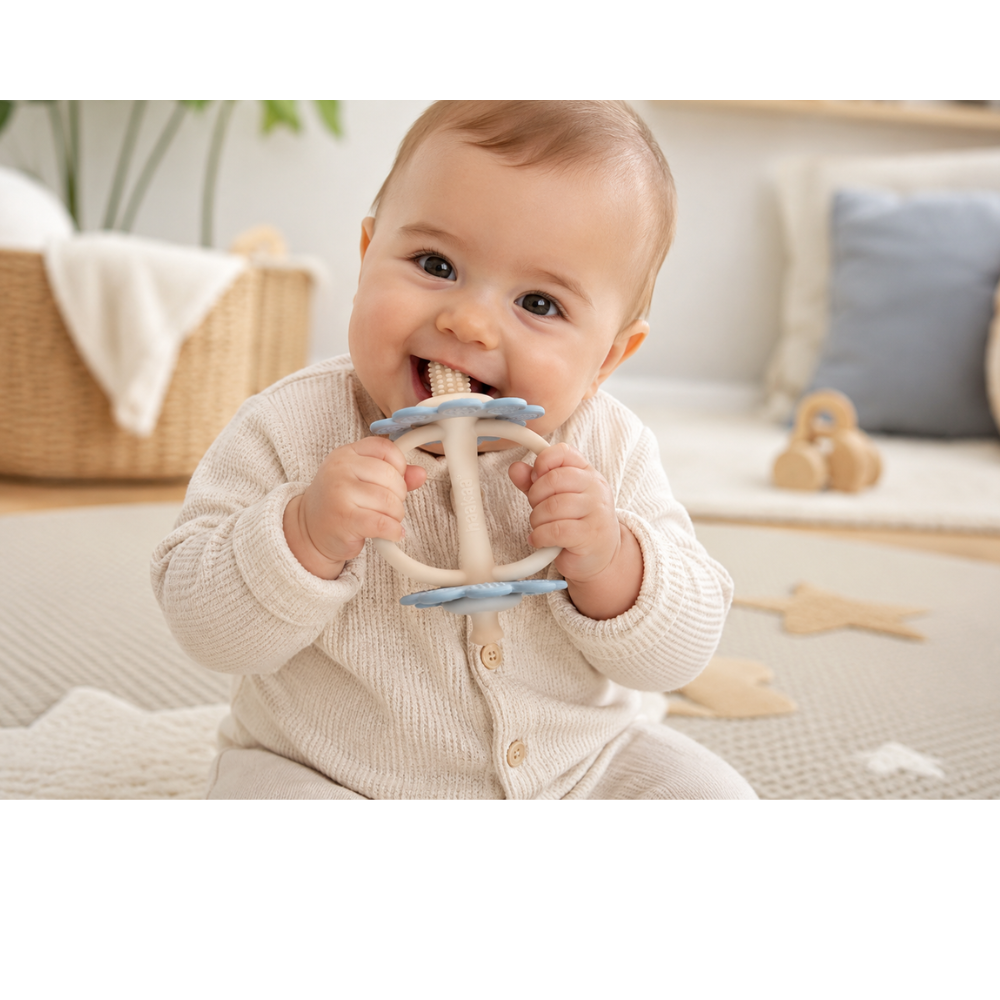
One week your baby is happily gumming a toy. The next, they are drooling through three bibs, chewing their fist like it insulted them, and acting generally unimpressed with the day. It is natural to wonder: is this teething, or just a rough stretch?
Often, it may be teething. But not every fussy day, sleep wobble, or fever should be pinned on a new tooth.
Here’s the practical version: teething is a normal part of development, it usually starts sometime in the first year, and the safest ways to help are simple ones like gum massage, appropriate teethers, and cool comfort. The bigger job for parents is knowing what fits teething, what does not, and which remedies are best left on the shelf.
Baby Teething: The 5 Ws and How
What is baby teething?
Teething is the process of a baby's primary teeth, also called baby teeth, moving through the gums and becoming visible in the mouth.
Your baby is born with these developing teeth underneath the gums. Over time, those teeth begin erupting into the mouth.
The first teeth most commonly appear somewhere around 6 to 10 months, although every baby develops differently. Some babies get teeth earlier. Others may not have their first tooth until closer to their first birthday.
Teething itself is not an illness. It is a normal developmental milestone.
Why do babies teethe?
Because they are growing the teeth they will need as they get bigger.
Baby teeth do eventually fall out, but they still matter. Primary teeth help children:
- Bite and chew food
- Learn to speak clearly
- Maintain space for the permanent teeth that will eventually replace them
The American Dental Association explains that baby teeth help hold the proper spaces for permanent teeth as a child's mouth develops.
So teething is not a sign that something is wrong. It is part of normal growth and oral development.
When does baby teething start?
There is no one exact age.
Many babies get their first teeth at around 6 months, while the normal range stretches across much of the first year. You may notice more drooling, chewing, and mouthing before any tooth actually appears.
One detail is worth keeping in mind: a 3-month-old putting everything into their mouth does not automatically mean a tooth is on the way.
Around 3 months, babies often start exploring the world with their mouths and making more saliva. That can look very teething-ish, even when no tooth is close.
The two front teeth are commonly among the first to show up.
Every baby runs on their own schedule, so it is not especially useful to compare your child with another baby the same age who already has a tiny picket fence forming.
Who gets teething symptoms?
Nearly every child eventually goes through tooth eruption, but not every baby reacts the same way.
One baby may seem barely bothered.
Another may be noticeably uncomfortable for a few days while a tooth is pushing through.
That is why teething comparisons rarely help much. The better guide is your baby’s usual behavior, plus what you can see in their gums.
Where does teething discomfort come from?
The discomfort is usually centered around the part of the gum where the new tooth is emerging.
You may notice one area looks:
- Slightly swollen
- Tender
- Redder than usual
Your baby may keep pressing fingers, toys, or other objects against that spot because chewing can feel temporarily soothing.
How can you tell if your baby is teething?
There is no single symptom that proves a tooth is coming. Usually, parents notice a cluster of changes rather than one dramatic sign.
Common signs of teething
1. Chewing everything
Your baby’s fingers.
Your fingers.
Toys.
Their bib.
Anything they can safely reach.
A stronger urge to chew is one of the most familiar teething signs. Pressure against sore gums can feel good.
2. More drooling
Drooling often ramps up during the same stage of infancy when teething begins.
Still, drooling alone does not prove teething. More saliva is also a normal part of early development.
3. Tender or swollen gums
Take a gentle look inside your baby’s mouth. You may see one area where the gum looks puffier or more sensitive than usual.
4. Mild fussiness
Some babies are a bit more irritable while a tooth is coming through. They may want extra comfort, have less patience, or seem out of sorts for a few days.
5. Wanting to bite or gnaw
This is where having a suitable teething toy nearby can make daily life easier. It gives your baby something designed for chewing instead of whatever random household object they have managed to claim.
What actually helps a teething baby?
You do not need a drawer full of special gadgets. Start with the simple things that directly address sore gums.
1. Gently massage your baby’s gums
Wash your hands and gently rub the tender gum with a clean finger.
The American Academy of Pediatrics recommends gum massage as a straightforward way to help soothe teething discomfort.
Sometimes that little bit of pressure is exactly what your baby was looking for.
2. Offer a safe teething toy
A baby teether gives your child an appropriate object to chew instead of whatever they happen to grab first.
Rubber and silicone-style chew toys can provide a firm but comfortable surface for sore gums.
A teether we like: Haakaa Silicone Baby Teether
When your baby hits the "everything goes into my mouth" stage, an easy-to-grab teether can be genuinely handy.
The Haakaa Silicone Teether gives baby a soft, textured surface designed specifically for chewing.
That does not make it a cure, and it does not make teething vanish. What it can do is give your baby an appropriate chewing surface that may help soothe tender gums.
That is the useful distinction. A teether may reduce the chaos a bit. It does not change the fact that the tooth still has to come through.
3. Try something cool
Cool temperatures can feel soothing on sore gums.
A chilled teether or a cool, damp washcloth may help.
But cool and frozen solid are not the same thing. Very hard frozen teething rings can be too harsh on tender gums. Follow the manufacturer’s instructions for any teething product rather than automatically tossing it into the freezer and hoping for the best.
4. Give extra comfort
Sometimes your baby mostly wants you.
Holding, cuddling, distracting, or settling into a calm stretch of play may help them through a rough patch. Not every uncomfortable moment needs a new product attached to it.
Silicone teethers: helpful, with limits
A silicone teether can be a useful tool, but it helps to be clear about what it does and does not do.
Pros
✓ Gives baby an appropriate surface to chew
Instead of chewing random objects, your baby has something intended for that purpose.
✓ May help soothe tender gums
Chewing and gentle pressure can temporarily ease discomfort.
✓ Easy to keep nearby
A teether is simple to stash in a diaper bag, keep by the play mat, or hand over during a fussy stretch.
✓ Reusable
Unlike single-use options, a good teether can be cleaned and used repeatedly throughout the teething stage.
✓ Can encourage grasping
A teether made for small hands also gives your baby another object to practice holding and moving around.
Cons
✗ It will not stop teething
The teeth still have to erupt. A teether provides comfort; it does not speed up the process or prevent it.
✗ Not every baby likes the same texture
Some babies love silicone. Others prefer a cool washcloth or a different shape entirely. A teether your friend swears by may get tossed aside by your child within seconds. Babies are efficient critics.
✗ It needs frequent cleaning
A teether spends a lot of time:
in your baby’s mouth,
on the floor,
in the stroller,
and occasionally launched farther than seems reasonable.
Clean it according to the manufacturer’s instructions and inspect it regularly for damage.
✗ A teether does not replace medical care
If your baby seems sick rather than mildly uncomfortable, do not assume teething is the whole explanation.
That distinction matters.
What not to use for baby teething
This part is at least as important as the list of things that can help.
Avoid benzocaine teething products
The U.S. Food and Drug Administration warns against using benzocaine products for teething pain in young children because they can cause a rare but potentially life-threatening blood condition called methemoglobinemia.
Do not assume that because something is sold as an oral numbing product, it is automatically appropriate for a baby.
Avoid amber teething necklaces
Teething necklaces and beads are not something I would recommend around a baby’s neck.
The American Academy of Pediatrics warns about risks including choking and strangulation and recommends safer alternatives such as appropriate chew toys instead.
A teething product should not create a whole new safety issue while trying to solve a smaller one.
Don’t freeze teethers rock-hard
Cooling can help.
Freezing solid is different.
An extremely hard frozen object can be rough on sensitive gums. Keep teethers cool according to the product instructions rather than assuming colder is always better.
Does teething cause fever?
This is one of the most important misconceptions to clear up.
A true fever should not automatically be blamed on teething.
Your baby’s temperature may rise slightly, but evidence does not support teething as the cause of a true fever. The American Academy of Pediatrics advises parents that a temperature around 38°C / 100.4°F or higher may indicate illness rather than simply teething.
This matters because it is easy to tell yourself, it is probably just teeth, and miss an actual illness.
What symptoms should not be blamed on teething?
Teething may come with things like:
- Tender gums
- Increased chewing
- Drooling
- Mild irritability
But symptoms such as significant fever, vomiting, diarrhea, or a baby who appears genuinely ill should not simply be dismissed as teething.
If something seems unusual or your baby appears unwell, contact your baby’s healthcare provider.
What about pain medicine?
Some babies barely notice teething. Others hit the occasional very uncomfortable evening.
If your baby seems to be in significant pain, speak with your pediatrician, pharmacist, or other qualified healthcare professional about whether an age- and weight-appropriate pain medication is suitable.
Medication dosing for babies should be based on the specific child, age, weight, and medication instructions, not a guessed number pulled from the internet at 2 a.m. The American Academy of Pediatrics recommends discussing appropriate dosing with your child’s clinician when medication is needed.
For ordinary teething discomfort, simple measures like gum massage and appropriate chew toys are a sensible place to start.
The first tooth appeared. Now what?
Once that first tiny tooth breaks through, oral care starts.
Begin brushing as soon as the first tooth appears.
The American Dental Association recommends brushing baby teeth twice daily with a small, soft-bristled toothbrush and a tiny amount of fluoride toothpaste—about the size of a grain of rice.
At that point, the question shifts from:
How do I soothe these gums?
to:
How do I protect these little teeth?
Baby teeth may be temporary, but caring for them still matters.
Quick teething guide for parents
What?
Teething is the normal process of baby teeth emerging through the gums.
Why?
Baby teeth are needed for chewing, speech development, and maintaining space for future permanent teeth.
When?
The first tooth commonly appears around the middle of the first year, although there is a wide range of normal.
Who?
Every baby eventually develops teeth, but timing and symptoms vary a lot.
Where?
Discomfort is usually focused around the section of gum where a tooth is emerging.
How can you help?
Try gentle gum massage, an appropriate teething toy, and something safely chilled.
Final take
Teething can be uncomfortable, but it does not need to become a giant mystery or a shopping project.
Start with the basics:
Notice the signs.
Offer something appropriate to chew.
Try gentle gum massage.
Use cool items, not rock-hard frozen ones.
Keep teethers clean and check them regularly.
And most importantly, do not assume every illness symptom is caused by teething.
A soft silicone teether like the Haakaa Silicone Baby Teether may be a helpful addition during this stage because it gives your baby an appropriate place to direct that determined need to chew. But it works best as a support, not a substitute for judgment.
Teething is usually less about finding the perfect remedy and more about recognizing what is normal, offering a little relief, and giving those tiny teeth time to do their slow work.
Health and safety note: This guide is general education, not individualized medical advice. For current recommendations on teething care, fever, pain medicines, oral care, and product safety, follow the guidance of your local health authorities, approved product instructions, recall systems, and your child’s qualified healthcare team where you live. If your baby has a true fever, seems unwell, has concerning symptoms such as vomiting or diarrhea, or you are worried about breathing, choking, dehydration, or unusual sleepiness, seek local urgent or emergency care right away.
Keep reading
Two useful next stops.
2026-08-23
Diaper Changes 101: Keep Baby Clean & Rash-Free
A simple, first-time-parent guide to diaper changes: how often to change diapers, when to use wipes, how to clean gently, what diaper cream actually does, and when a rash needs medical attention.
2026-08-23
Starting Solids? What to Know About Using a High Chair Safely and Choosing One That Fits Real Life
A practical guide to when babies are ready for a high chair, which safety features matter most, how to keep cleanup manageable, and whether a convertible model is worth considering.