SoftNest Journal
Self-Feeding at 6 Months: What It Really Teaches Your Baby (and What It Doesn’t)
A practical guide to self-feeding around 6 months: the skills it builds, how to spot readiness, and where a beginner utensil like the NumNum Pre-Spoon GOOtensils fits in—without the sales pitch.
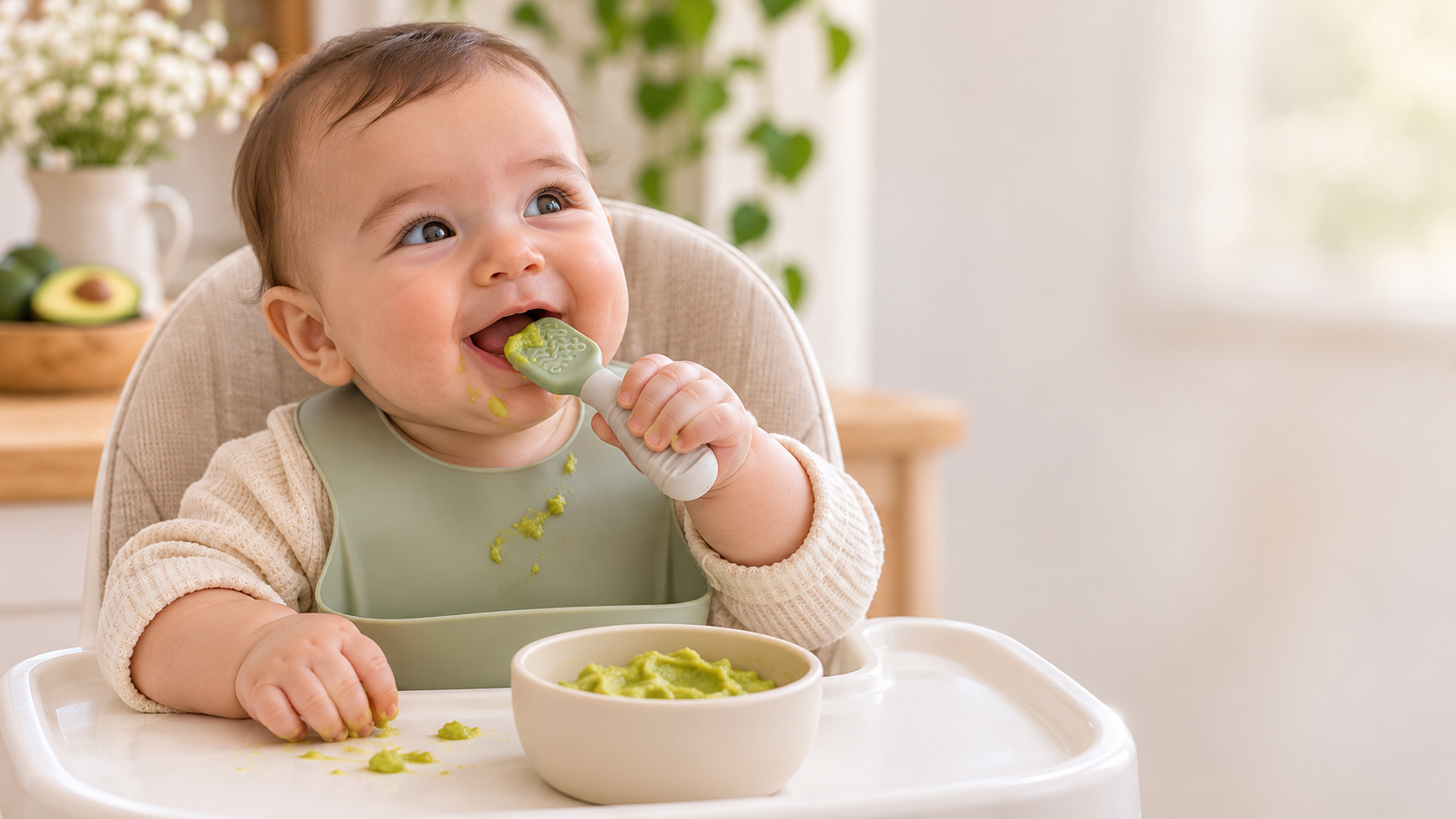
The spoon leaves the bowl, tips sideways, and lands yogurt-side down on the tray. Your baby looks at you, delighted. You look at the bib, the floor, and the small patch of avocado in their hair. Starting solids is exciting, but it also raises a very practical question: should you spoon-feed every bite, or let your baby take the wheel?
The short answer is that around 6 months, many babies begin showing signs they’re ready to explore food alongside breast milk or formula. The CDC and American Academy of Pediatrics recommend introducing complementary foods at about 6 months, when a baby is developmentally ready. Self-feeding doesn’t mean your baby masters a spoon right away. It means giving them chances to touch, grab, explore, and bring food or a pre-loaded utensil toward their mouth. That participation is part of learning to eat.
Why a Regular Spoon Is a Big Ask
Hand a baby a standard spoon and the challenge becomes clear. Food goes on top, the spoon flips, and suddenly the yogurt is everywhere except the mouth. That’s normal. Using a traditional spoon takes coordination, balance, and movements babies are still developing. The CDC notes that babies keep improving their ability to use feeding utensils over time and generally get much better at independently using spoons and forks as they grow.
That doesn’t mean you have to wait before letting them join in. For babies who are developmentally ready, starting with something simpler—touching food, picking up soft pieces, or holding a pre-loaded beginner utensil—lets them practice without being expected to scoop perfectly.
What Self-Feeding Actually Builds
Self-feeding isn’t only about getting food into your baby’s belly. It’s a learning experience, and the skills it practices are worth knowing about.
It practices fine motor skills
Picking up food, holding a utensil, and bringing it to the mouth asks babies to coordinate hands, fingers, eyes, and mouth. The CDC specifically notes that picking up food with the fingers helps babies develop fine motor skills. Every messy attempt is practice.
It encourages independence
The American Academy of Pediatrics notes that one potential benefit parents associate with baby-led approaches is encouraging independence while babies practice grasping food, handling utensils, chewing, and swallowing. Think of it as guided independence: you prepare the food safely, stay right beside them, and help when needed—but your baby gets a chance to participate.
Mealtime becomes a sensory experience
To you, mashed avocado is just food. To a 6-month-old, it’s an experiment. What does it feel like? Is it warm or cold? Smooth or lumpy? What happens when I squeeze it? Introducing babies to different appropriate tastes and textures is an important part of learning about food. The CDC recommends gradually offering a variety of foods that match your baby’s developmental eating skills. Yes, some learning ends up on the tray, the bib, the floor, and probably in their hair. That mess is part of the experience.
Babies can begin learning hunger and fullness cues
Letting babies participate in eating also gives them some control over the pace of the meal. You offer the food. Your baby decides whether they want another bite. The CDC recommends watching for hunger and fullness cues, such as opening the mouth when interested or turning the head away when they’ve had enough. Creating that responsive feeding environment from the beginning can make mealtimes feel less like a battle and more like exploration.
The Trouble With Starting on a Standard Spoon
Scooping food, keeping the spoon upright, balancing the food, turning the spoon correctly, and actually getting it into the mouth is a lot for a beginner. A standard spoon isn’t exactly designed for someone who has only been using their hands for a few months.
This is where a pre-spoon can make those first attempts a little easier.
A Helpful First Step: NumNum Pre-Spoon GOOtensils
If your baby is beginning solids and you want to give them a chance to participate in feeding, the NumNum Pre-Spoon GOOtensils are an alternative to starting immediately with a traditional spoon. Instead of a deep spoon bowl that needs to stay perfectly upright, the NumNum has a flat beginner-friendly design, so there isn’t really a “wrong” direction for baby to hold it.
You can pre-load it with foods such as yogurt, oatmeal, purées, mashed avocado, mashed vegetables, and other soft foods appropriate for your baby’s stage. Then baby can practice grasping the thicker handle and bringing the utensil toward their mouth.
The set includes two stages. The Stage 1 GOOtensil is designed for babies 6+ months and has a textured flat head that can hold small amounts of soft food. Stage 2 is designed for later development and has a deeper design for thicker foods.
Why it can help beginners
The NumNum GOOtensils don’t magically teach babies how to use a spoon. What they do is remove one of the hardest parts of using a regular spoon: scooping and balancing the food. Baby can focus on something simpler: grab, bring to mouth, taste. For a little learner, that is already a big accomplishment.
Every Baby Develops Differently
Six months is not a magic date when every baby suddenly needs to start feeding themselves. Look at your baby’s development, not just the calendar. Signs of readiness for complementary foods can include:
- Good head and neck control
- Sitting alone or with support
- Bringing objects toward the mouth
- Showing interest when food is offered
- Swallowing food instead of automatically pushing it back out
- Reaching for or grasping objects
These are among the developmental signs recommended by the CDC when deciding whether a baby is ready to begin complementary foods.
Always seat your baby upright and supervise them closely while they’re eating. Prepare foods in an age- and developmentally appropriate texture and shape to reduce choking risk. And remember that during the first year, solids are complementary foods. From 6 to 12 months, breast milk and/or infant formula remains an important primary source of nutrition while babies gradually learn to eat more solid foods.
The Takeaway
Starting solids isn’t about having a baby who eats perfectly. It’s about learning: how food feels, how to grasp, how to bring something to the mouth, and new tastes and textures. Eventually, it’s about learning how to feed themselves.
Don’t worry if the first few meals are messy or only a tiny amount of food actually gets eaten. Those attempts are still helping your baby practice important skills. If you’re looking for something that can make those first self-feeding attempts a little easier, the NumNum Pre-Spoon GOOtensils can be a simple beginner-friendly tool to introduce when your baby is developmentally ready.
Sometimes the goal isn’t a perfectly clean plate. It’s giving your little one the opportunity to learn—one messy bite at a time. NumNum Pre-Spoon GOOtensils
Health and safety note: This article is general education, not individualized advice. Always follow current guidance from health authorities and your child’s healthcare team where you live, and follow product instructions. Choking risks and readiness signs can vary; if you have concerns about your baby’s feeding, swallowing, or development, or if a choking event occurs, seek help from qualified local professionals or emergency services.
Keep reading
Two useful next stops.
2026-08-23
Starting Solids? What to Know About Using a High Chair Safely and Choosing One That Fits Real Life
A practical guide to when babies are ready for a high chair, which safety features matter most, how to keep cleanup manageable, and whether a convertible model is worth considering.
2026-07-19
Starting Solids Without Turning Every Meal Into a Test
A practical first-food guide for readiness, iron-rich choices, purées, finger foods, allergens, choking prevention, milk feeds, and calmer family meals.