SoftNest Journal
Starting Solids Without Turning Every Meal Into a Test
A practical first-food guide for readiness, iron-rich choices, purées, finger foods, allergens, choking prevention, milk feeds, and calmer family meals.
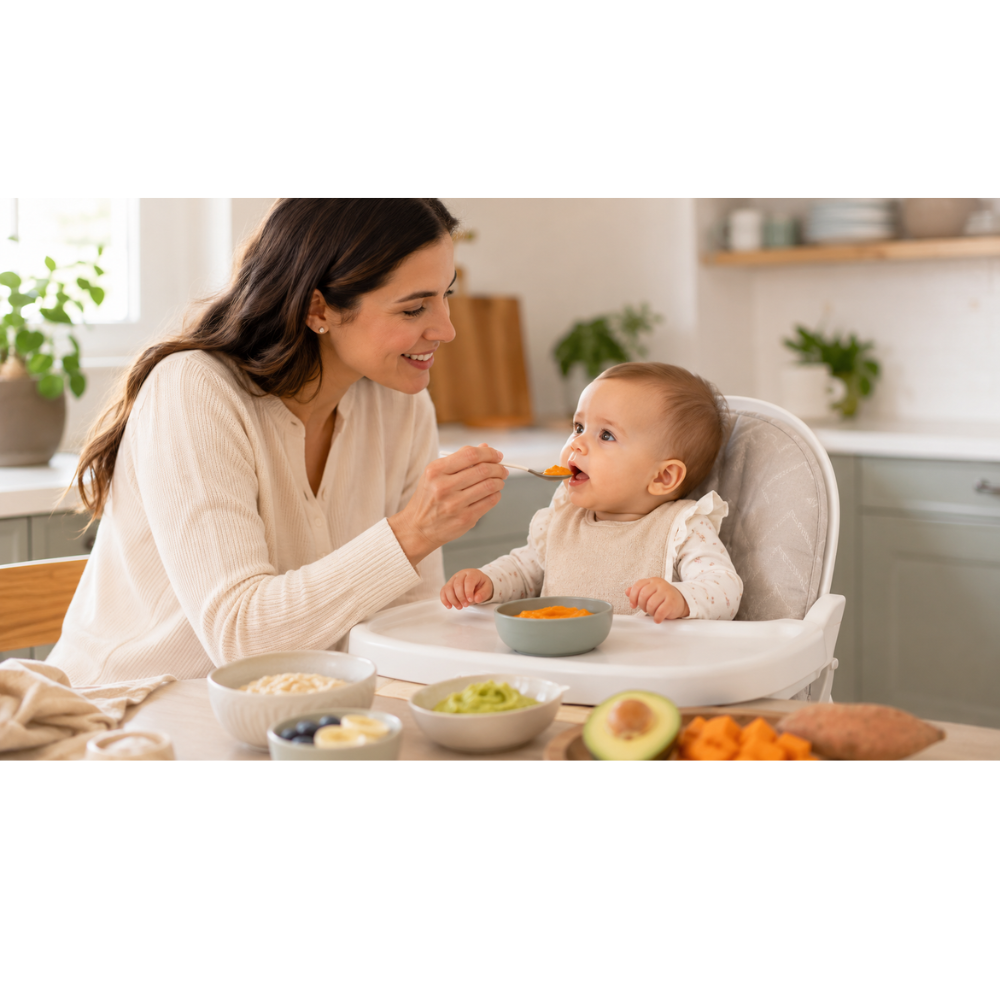
The first solid meal often contains one spoonful of food and enough adult concentration to land an aircraft.
The baby sits in the high chair. The bib is clean for the last time. A parent presents a little mashed food. The baby touches it, looks offended, smears it into one eyebrow, and perhaps swallows an amount too small to enter the historical record.
This is not a failed meal. This is the meal.
Starting solids is a gradual transfer of skills. The baby is learning to sit at the table, handle new textures, move food through the mouth, reach, grasp, swallow, and signal “more” or “finished.” The parent is learning which chair angle works, how soft is soft enough, what the baby does when gagging, and why three clean cloths can disappear before noon.
Food joins breast milk or infant formula at around six months when the baby is developmentally ready. It does not march in and dismiss milk on the first day.
That single idea removes much of the panic. The early goal is not to produce a miniature adult meal or hit an impressive number of spoonfuls. It is to begin safely, offer useful nutrients, follow the baby’s cues, and build the next meal from what you learned at this one.
“Weaning” Does Not Mean Milk Ends on Monday
The word weaning causes unnecessary trouble because it means different things in different places.
Here it means complementary feeding: adding foods alongside breast milk or infant formula. Between roughly six and twelve months, milk remains a central source of nutrition while food gradually takes on a larger role. The balance changes over months, not over a long weekend.
Do not remove milk feeds abruptly because the baby tasted banana. Do not add cereal to a bottle in the hope of producing a longer night. Do not turn a few accepted bites into evidence that the baby no longer needs the usual feeding plan.
Continue breast milk or correctly prepared infant formula and follow the baby’s healthcare guidance. Babies born prematurely, babies with growth concerns, and babies with medical, developmental, oral-motor, or swallowing difficulties may need an individualized schedule and texture plan.
For everyone else, start with a more useful question than “How do we wean?”
Ask: “Is this baby ready to practise eating?”
Readiness Is a Group of Skills
Many babies are ready for complementary foods at about six months. The calendar matters, but the calendar does not sit in the chair.
Look for several readiness signs together:
- the baby can hold the head and neck steady
- the baby can sit upright alone or with support and remain stable for eating
- the baby opens the mouth when food is offered
- the baby brings objects toward the mouth
- the baby can move food back and swallow rather than pushing nearly everything out
- the baby reaches or grasps with growing coordination
- the baby can turn away, close the mouth, or otherwise show they are finished
Watching adults eat, grabbing a spoon, waking more often, or being a large baby does not establish readiness by itself. Interest is charming. Posture and swallowing skill are more important.
Do not rush an unsteady baby into solids to solve sleep or because another baby of the same age is eating toast online. If the baby collapses sideways in the chair, cannot control the head, or consistently cannot manage an appropriate soft texture, pause and ask a qualified healthcare professional for advice.
A few weeks can change the entire scene.
Set Up the First Meal to Be Uneventful
Choose a time when the baby is awake, comfortable, and neither frantic with hunger nor exhausted. A desperate baby does not want a seminar on lentils.
Use a stable high chair or other feeding seat designed for the baby’s stage. Fasten the restraint. Position the baby upright with good head and trunk support, following the chair instructions. An appropriate foot support can improve stability when the chair provides one.
Then simplify the table:
- one small portion of a soft, suitable food
- one baby-sized spoon if using one
- a clean cup if small sips of water are part of the local feeding guidance
- a cloth for the baby
- a larger cloth for the consequences
Stay seated or close enough to supervise directly. Meals are not the moment to answer the door, unload the dishwasher, or turn around to prepare the next course.
Start with a small amount. A teaspoon or two may be plenty for an introduction, and much of it may remain outside the baby. Offer more if the baby asks for more. Stop when the baby closes the mouth, turns away, pushes food away, slows down, or loses interest.
The parent decides what suitable food is offered and where. The baby decides whether and how much to eat.
That arrangement saves years of argument if everybody honours it early.
Begin With Food That Has a Job
There is no mandatory first fruit and no sacred order in which vegetables must report for duty.
The first foods should be safe in texture, manageable for the baby, and nutritionally useful. Iron deserves particular attention around this stage. Depending on how a baby is fed and their individual health, iron needs may be met through iron-rich foods, iron-fortified infant cereal, formula, or supplements recommended by a clinician.
Practical iron-rich choices include:
- iron-fortified infant cereals such as oat, barley, or multigrain cereal
- tender meat or poultry, finely minced, shredded, mashed, or puréed as appropriate
- well-cooked egg in a safe texture
- beans, lentils, and chickpeas cooked until very soft and mashed
- tofu prepared in a manageable form
- fish cooked thoroughly with every bone removed
Plant sources of iron can be served with vitamin C-rich foods such as broccoli, sweet potato, tomato, berries, or suitable fruit. The entire meal need not become a nutrient spreadsheet. Pairing foods is enough.
Add variety around that foundation:
- avocado
- plain pasteurized yogurt without added sugar
- cooked vegetables soft enough to mash easily
- ripe, soft fruit prepared for the baby’s skill
- oats and other grains
- soft toast or pasta in an appropriate shape
- smooth soups or family dishes adapted before excess salt is added
The first meal can be infant cereal. It can be mashed lentils. It can be egg. It does not need to be an apple purée merely because apple has a good publicist.
Purées and Finger Foods Are Not Rival Political Parties
Some families begin with spoon-fed purées or mashed food. Others offer soft pieces the baby picks up. Many combine the two, sometimes in the same meal.
All three routes can teach useful skills when the baby is ready, the texture is appropriate, and feeding is responsive.
Spoon-feeding can make foods such as fortified cereal, yogurt, mashed beans, or blended meat easier to offer. Let the baby open for the spoon. Pause between bites. A preloaded spoon that the baby holds can bridge spoon-feeding and self-feeding.
Finger foods let the baby practise reaching, grasping, bringing food to the mouth, and deciding what to explore. The food must be soft and shaped for the baby’s current ability. A strip, piece, or mash that works at one stage may need to change as the baby’s grasp and chewing skills develop.
The trouble begins when the method becomes more important than the child.
A baby-led approach is not permission to hand over ordinary adult food and hope. A purée approach is not permission to keep every texture perfectly smooth for months. Spoon-feeding is not force-feeding. Self-feeding is not proof that the baby swallowed a full serving.
Use the method that helps you offer safe texture, iron-rich food, variety, and responsive feeding in your actual kitchen.
There is no medal for ideological purity at the high chair.
Texture Should Move Forward, Not Leap Forward
Babies need experience with texture, but “experience” does not mean surprise.
Begin with food the baby can manage: smooth, mashed, or very soft depending on readiness and the feeding approach. As skill develops, move toward thicker mashes, soft lumps, finely chopped foods, tender shreds, and suitable finger foods.
Watch what happens in the mouth. Does the baby move the food, swallow, recover from a manageable gag, and remain comfortable? Or do they cough repeatedly, choke, struggle to breathe, sound wet or congested while eating, vomit often, tire quickly, or appear unable to coordinate swallowing?
Persistent difficulty is not something to train through with a tougher texture. Ask for a feeding or medical assessment.
For routine progression, change one thing at a time. Make the familiar lentils slightly thicker. Offer the same soft vegetable in a graspable form beside the mash. Put a small amount on a preloaded spoon. This gives the baby a new problem with an old flavour.
If homemade food is taking over the week, Homemade Baby Food Without Turning the Kitchen Upside Down focuses on batching and equipment without pretending that every meal needs its own appliance.
Gagging Is Noisy; Choking May Be Quiet
Gagging and choking are not the same.
Gagging is a protective response as a baby learns to manage food. The baby may cough, make noise, push the tongue forward, water at the eyes, or bring food back toward the front of the mouth. It can look dramatic because babies have not learned to perform it discreetly.
Choking means the airway is blocked. The baby may be unable to breathe, cry, or cough effectively. It is an emergency.
Parents and every regular caregiver should learn infant choking response and CPR from a qualified local provider before or as solids begin. A paragraph cannot replace hands-on training.
Reduce risk at every meal:
- seat the baby upright in a suitable secured chair
- supervise directly from within reach
- prepare food for the baby’s current skill, not merely their age
- remove bones, hard pits, tough skins, and inedible parts
- cook hard produce until soft
- alter round or cylindrical foods so they are not served as airway-sized coins or balls
- avoid hard, small, sticky, or tough foods the baby cannot manage
- keep meals calm; do not feed while the baby is lying down, crawling, walking, riding in a moving vehicle, or distracted by play
Do not rely on a “no choking” gadget or a particular feeding philosophy. Preparation, posture, supervision, and caregiver training do the serious work.
Common Choking Hazards Need a Different Form
Many nutritious foods become hazardous because of shape or texture, not because the ingredient itself is forbidden.
Avoid serving a baby:
- whole nuts
- spoonfuls or lumps of thick nut butter
- whole grapes or cherry tomatoes
- round slices of sausage or hot dog
- popcorn
- hard raw apple or carrot
- hard candy, gum, or marshmallows
- large tough chunks of meat or cheese
- fish with bones
- whole beans or other firm round foods the baby cannot manage
- food held on toothpicks or skewers
Some can be changed. Nut butter can be thinned smoothly into another food. Nuts can be finely ground and mixed into a suitable texture. Grapes and tomatoes can be cut according to current child-feeding guidance. Meat can be made tender and shredded or minced. Hard produce can be cooked until it mashes easily.
“Baby-sized” does not simply mean smaller. A small hard coin can be more dangerous than a larger soft piece. Use current preparation guidance that matches the baby’s developmental skill.
When uncertain, choose the softer and less cylindrical version and check a trusted health source before serving it.
Allergens Belong in a Plan, Not a Panic
Common food allergens include peanut, egg, cow’s milk products, wheat, soy, sesame, tree nuts, fish, and shellfish.
For many babies, these foods can be introduced when complementary feeding begins, in an age-appropriate, non-choking form. Delaying them without a medical reason is not the default modern approach. The exact plan may differ for a baby with severe eczema, an existing food allergy, a previous reaction, or another medical concern, so ask the baby’s clinician before introduction when those risks apply.
Make the first exposure boring and observable:
- Offer one common allergen at a time, early in the day when the baby is well.
- Use a small amount in a safe texture, such as smooth peanut butter thinned into cereal or purée, or well-cooked egg mashed appropriately.
- Keep the rest of the meal familiar.
- Watch for a reaction and follow the current interval and repeat-exposure advice given by your local health authority or clinician.
- If tolerated, keep the food in the family’s regular rotation rather than treating one taste as a completed assignment.
Possible reactions can include hives, swelling, repeated vomiting, coughing, wheezing, breathing trouble, or sudden marked weakness or sleepiness. Follow the baby’s emergency plan if one exists. Breathing difficulty or swelling involving the mouth or throat requires emergency help.
Do not rub food on the skin as a home allergy test. Do not give whole nuts. Do not put a thick spoonful of nut butter into a baby’s mouth. The ingredient may be appropriate while the form is not.
Keep a Short List of Foods That Wait
The first-food period does not need many prohibitions, but a few matter.
Honey
Do not give honey in any form before 12 months because of the risk of infant botulism. Baking it into food does not turn it into baby food.
Cow’s milk as the main drink
Breast milk or infant formula remains the appropriate milk feed through the first year unless the baby’s healthcare plan says otherwise. Pasteurized yogurt and cheese may be offered as foods when suitable, but cow’s milk should not replace breast milk or formula as the main drink before 12 months.
Unpasteurized and undercooked foods
Avoid unpasteurized dairy or juice and raw or undercooked eggs, meat, poultry, fish, or shellfish. Prepare and store food hygienically, wash hands and surfaces, separate raw animal foods, and refrigerate leftovers promptly according to local food-safety guidance.
Added sugar, excess salt, and unsuitable drinks
Babies do not need sweetened drinks, caffeinated drinks, or food built around added sugar. Avoid heavily salted food and salty processed products. Small sips of water may be offered with meals from around six months where current local guidance recommends it, but water should not displace breast milk or formula.
The restriction list is not meant to make food joyless. It is meant to remove avoidable risk while the baby discovers ordinary food.
Milk Feeds Do Not Need a Sudden Demotion
Early solid meals are small and unreliable. Milk feeds are not.
Continue the baby’s normal breast-milk or formula pattern as solids begin. Some families offer milk before the earliest meals so the baby arrives calm rather than furious. Others find a window between feeds when the baby is interested but not full. Follow hunger cues, growth guidance, and the healthcare plan rather than a universal clock.
Over time, food intake and meal frequency grow while milk remains important. Do not reduce bottles or breastfeeds simply to make the baby eat more at the table. Pressure often makes the table less useful, not more.
If the baby’s milk intake drops sharply, wet diapers decrease, weight gain is a concern, or meals are replacing milk faster than expected, contact the baby’s healthcare professional.
A six-month-old who ate half a strawberry has not resigned from formula.
How Much Is Enough at the Beginning?
There is no useful daily quota for the first spoonfuls.
Start small. Offer more when the baby reaches, opens the mouth, leans toward food, or otherwise signals interest. Stop when the baby closes the mouth, turns away, pushes the spoon or food away, slows down, or becomes upset.
One day the baby may eat several spoonfuls. The next day the baby may lick the spoon and conduct a gravity experiment with the rest. Appetite varies with sleep, teething, illness, milk intake, and mood.
Look at progress over time:
- Is the baby meeting food in a safe, regular way?
- Are iron-rich and varied foods appearing repeatedly?
- Are textures advancing with skill?
- Is the baby allowed to practise self-feeding?
- Are milk feeds continuing appropriately?
- Is growth being followed through normal healthcare?
Those questions tell you more than the amount left in one bowl.
Never scrape the last spoonful into a closed mouth to make the meal count. The baby is learning that their fullness signals matter.
A Practical First-Two-Weeks Rhythm
This is an example, not a prescription.
The first few meals
Offer one small eating opportunity at a calm time of day. Choose one iron-rich food in a manageable texture. Let the baby explore. Keep the meal short enough that everybody leaves before it becomes a dispute.
Examples:
- iron-fortified oat cereal mixed to a suitable texture
- mashed lentils with a little soft sweet potato
- well-cooked egg mashed or offered in an appropriate soft form
- finely prepared tender meat with a familiar vegetable
After the basic mechanics improve
Add variety and begin moving texture forward. Offer a second food beside the iron-rich option. Introduce a preloaded spoon or suitable finger food. Bring common allergens into the plan one at a time as appropriate.
Examples:
- plain yogurt with soft mashed fruit
- tofu with very soft broccoli
- boneless fish with mashed potato
- avocado beside fortified cereal
- soft toast with a thin, smooth allergen preparation appropriate for the baby
When one meal feels ordinary
Add another eating opportunity when the baby is interested and the family can supervise properly. There is no need to build breakfast, lunch, and dinner simultaneously because a schedule chart said so.
For ways to get more variety from fewer cooking sessions, More First Foods, Fewer Kitchen Sessions offers a practical batch-and-rotate approach.
The aim is a sustainable rhythm. A heroic first week followed by exhaustion is not a feeding strategy.
Equipment Should Remove Work
You need less equipment than the baby industry suggests.
The useful basics are:
- a stable, easy-to-clean feeding chair with the correct restraint
- one or two small spoons
- an open cup or suitable training cup
- a washable bib if the baby tolerates it
- ordinary bowls or a suction bowl if throwing becomes the main event
- a safe knife, fork, masher, or blender already in the kitchen
- containers for hygienic cooling, labelling, and storage
A steamer-blender or baby food maker can be convenient for a family preparing purées or batches several times a week. It is not required. A saucepan and fork have launched many competent eaters.
Buy equipment after the routine reveals a repeated inconvenience. If cleaning a special appliance takes longer than mashing the food, the appliance has misunderstood its position.
The high chair deserves the most attention because posture, restraint, cleaning, and direct supervision matter every day. Make sure the baby fits according to the chair instructions. Keep straps clean and correctly adjusted. Never rely on the tray as the restraint.
Refusal Is Information, Not Insolence
Babies often need repeated, low-pressure encounters with a food or texture. One rejected spoonful does not establish a lifelong hatred of broccoli.
When the baby refuses:
- stop pushing the food toward a closed mouth
- offer a familiar food alongside it another day
- change the texture or temperature without turning it into dessert
- let the baby touch and smell it
- model eating it at the family table
- keep the portion small enough that waste does not feel personal
Do not hide every vegetable inside a sweeter food. Familiarity includes seeing, smelling, and tasting the actual food. It is fine to combine ingredients, but the long-term goal is variety, not concealment.
Avoid using food as a reward or punishment. Avoid praising the baby for clearing a bowl as if appetite were obedience. Calmly offer, observe, and clear away.
This approach can feel slow because it is slow. Learning usually is.
Family Food Can Become Baby Food With an Earlier Exit
Separate baby recipes can exhaust a household quickly.
Look at the family meal before it is heavily salted, sweetened, or made spicy beyond the baby’s tolerance. Set aside suitable ingredients and change the texture:
- shred tender chicken before adding a salty sauce
- mash beans from an unsalted portion
- steam extra vegetables until very soft
- remove every fish bone with unreasonable care
- reserve plain yogurt before sweetening toppings appear
- adapt oatmeal, lentils, pasta, egg, tofu, or soft fruit
The baby does not need a tiny plated version of dinner. One or two safe components are enough.
Batching can help, but cool and store food promptly. Label containers. Reheat only as current food-safety guidance allows. Discard food that has been contaminated by the used spoon or the baby’s saliva rather than returning it to the main container.
The freezer is a tool. It is not an archaeological site. Date things.
When to Ask for Individual Help
General feeding advice stops being enough when the baby’s situation is not general.
Speak with a qualified healthcare or feeding professional if the baby:
- was born prematurely or has a condition affecting feeding or nutrition
- has poor growth or weight concerns
- cannot sit or control the head as expected for feeding
- coughs, chokes, or struggles to breathe repeatedly during meals
- has difficulty swallowing or a persistently wet voice or breathing sound with food
- vomits frequently or appears in pain during feeding
- has severe eczema, a known food allergy, or a previous reaction
- accepts very few textures or consistently refuses food beyond the early learning stage
- has a major drop in breast-milk or formula intake
- produces fewer wet diapers or shows signs of dehydration or illness
Seek urgent or emergency help for breathing difficulty, a serious allergic reaction, choking, marked weakness, or any situation in which the baby may be seriously unwell.
A feeding guide can organize questions. It cannot examine the child.
The Starting-Solids Checklist
Before the meal:
- confirm the baby is around six months and showing several readiness skills
- choose a calm, awake window
- seat and secure the baby upright
- prepare one small portion in an appropriate texture
- keep breast milk or infant formula in the feeding plan
- know how to respond to choking
At the meal:
- supervise within reach
- let the baby set the pace
- watch posture and swallowing
- offer more only when the baby asks
- stop at fullness or distress
Across the week:
- include iron-rich foods regularly
- introduce variety without changing everything at once
- progress textures as skill grows
- introduce allergens according to current guidance and the baby’s risk plan
- keep meals clean enough to be safe and relaxed enough to repeat
That is the system. The rest is laundry.
The Point of the First Month
The first month of solids is not a performance review of the parent or the baby.
The baby should not be expected to eat a balanced dinner on day three. The parent should not be expected to produce homemade cubes in six colours, follow a rigid feeding doctrine, and enjoy every splatter.
Begin around six months when readiness skills are present. Keep breast milk or infant formula central. Offer iron-rich foods, safe texture, and growing variety. Combine spoon-feeding and finger foods if that suits the baby. Learn choking response. Introduce common allergens thoughtfully. Follow hunger and fullness cues.
Then repeat the meal without trying to make it historic.
The baby will learn that food has flavours, shapes, and textures. You will learn that mess is not a measurement of failure and that a closed mouth is a complete sentence.
The best starting-solids plan is not the one with the prettiest plate.
It is the one the baby can practise safely and the family can still manage tomorrow.
Health and safety note: This article provides general education and cannot assess a baby or replace individualized advice from a physician, paediatrician, nurse, registered dietitian, feeding therapist, allergy specialist, or other qualified professional. Readiness, allergen plans, food preparation, milk feeding, emergency response, and choking guidance can differ with a baby’s health and location; follow the baby’s healthcare plan and current local health-authority advice. Complementary-feeding guidance was checked against the WHO complementary-feeding guidance, CDC guidance on when and how to introduce foods, and CDC choking-hazard guidance. Learn infant choking response and CPR from a qualified provider, and seek urgent or emergency help when a baby may be choking, having a serious allergic reaction, or otherwise seriously unwell.
Keep reading
Two useful next stops.
2026-08-23
Starting Solids? What to Know About Using a High Chair Safely and Choosing One That Fits Real Life
A practical guide to when babies are ready for a high chair, which safety features matter most, how to keep cleanup manageable, and whether a convertible model is worth considering.
2026-08-23
Diaper Changes 101: Keep Baby Clean & Rash-Free
A simple, first-time-parent guide to diaper changes: how often to change diapers, when to use wipes, how to clean gently, what diaper cream actually does, and when a rash needs medical attention.